• Menu
  • Skip to primary navigation
  • Skip to secondary navigation
  • Skip to main content
  • Skip to primary sidebar

Inspiring Portfolio Careers

From Energise - The Talent Liberation Company

  • Home
  • You
    • Why choose a portfolio career?
    • Who is a portfolio career for?
    • What is a portfolio career?
    • When is it time for a portfolio career?
  • Us
    • Why choose us?
    • What is our approach?
    • What are our values?
    • Who are our clients?
  • Services
    • On-line programmes
    • Career Coaching
    • E-Course
    • Skills CV Design
    • Marketing Mentoring
    • Personal Branding
    • Booking
  • Inspiration
  • Testimonials
  • Blog
  • Contact Us
  • Website Terms & Conditions
  • Cookie Policy
  • Privacy Policy
  • Home
  • You
    • Why choose a portfolio career?
    • Who is a portfolio career for?
    • What is a portfolio career?
    • When is it time for a portfolio career?
  • Us
    • Why choose us?
    • What is our approach?
    • What are our values?
    • Who are our clients?
  • Services
    • On-line programmes
    • Career Coaching
    • E-Course
    • Skills CV Design
    • Marketing Mentoring
    • Personal Branding
    • Booking
  • Inspiration
  • Testimonials
  • Blog
  • Contact Us
You are here: Home / Archives for talent liberator

talent liberator

How to conduct a pre-termination negotiation

November 8, 2013 By //  by DigitalJenIPC

Sign pointing easy way or  hard way (Changing Work)

This is a guest blog about pre-termination negotiations or PTNs by Blair Adams, an employment lawyer at law firm DMH Stallard.

In July 2013, new legislation introduced the concept of pre-termination negotiations (PTNs). PTNs are confidential and will not be admissible in certain tribunal proceedings, the intention being to make it easier for employers to have off-the-record conversations with employees about agreed terminations. In addition, conducting a PTN and concluding a settlement agreement are now the subject of a new ACAS Code on Settlement Agreements. The Code is not legally binding, but it will be taken into account by tribunals.

What is a PTN?

It is simply a discussion about terminating employment on agreed terms. There are no particular formalities required under the legislation, but it would be prudent to establish with the employee at the beginning that you are starting a discussion or sending them a letter on the basis that it falls with the scope of a PTN.

What is the benefit?

It is an opportunity to try to agree terms with an employee before taking any formal steps, such as a performance management review or a disciplinary procedure. In contrast to the existing “without prejudice” rule, a PTN does not require there to be a pre-existing dispute.

What are the risks?

• loss of confidentiality;
• constructive dismissal claims – nothing in the legislation prevents an employee claiming constructive dismissal if you suggest that they should leave. In some cases, employees could use this to “manufacture” a wrongful dismissal that allows them to escape contractual restrictions.

How far does the confidentiality go?

• the confidentiality only applies in claims of ordinary unfair dismissal. Evidence of what happened in a PTN could still be admissible in other claims, such as discrimination or automatic unfair dismissal;
• all confidentiality is lost if one party is found to have behaved improperly in the course of a PTN;
• the confidentiality relates to employment tribunal proceedings – nothing in the legislation prevents an employee telling a third party about a PTN; and
• it can be removed in relation to costs applications in the tribunal – but a party needs to reserve its position on this at the time of the PTN.

Improper behaviour

This is defined in the Code. It is ultimately for a tribunal to decide what amounts to improper behaviour, but the Code provides examples. These include the obvious (physical assault, harassment, victimisation and discrimination, bullying and intimidation) and the concept of “undue pressure”.

Undue pressure

According to the Code, undue pressure includes:
• failing to allow a reasonable time for consideration of a settlement agreement (the Code suggests 10 calendar days is the minimum period);
• saying that if a settlement is not reached the employee will be dismissed (although the Code says it will not be improper to set out in neutral terms the “likely alternatives” to settlement); and
• an employee threatening to damage an employer’s public reputation if a settlement is not reached.

Concepts such as intimidation and undue pressure are ill-defined – expect disputes about them in the near future. For example:

• would a statement by the employer that the employee will get a less favourable reference unless terms are agreed amount to improper behaviour?
• could an employee claim to have been unduly pressured if you ask them to respond to a settlement agreement within fewer than 10 days?

Companions

The Code suggests that the right to be accompanied should apply during a PTN, although this is not a legal requirement and so the employee cannot insist on it. Many employers will want to ignore the suggestion, the risk being that they will be found to have behaved improperly.

Without prejudice confidentiality
PTNs may also fall within the scope of the existing without prejudice rule. In most cases, employers will want to use both labels if they can.

PS

On 29 July, compromise agreements were officially renamed “settlement agreements”.

To contact Blair Adams, employment lawyer, the guest blogger, click on this link:

http://www.dmhstallard.com/site/people/profile/blair.adams@dmhstallard.com

Filed Under: Employment law Tagged With: blair adams, DMH stallard, Employment law, energise, legal advice, pre determination negotiation, PTN, rachel brushfield, talent liberator

My inspiring clients. Part 2 of 4.

November 2, 2013 By //  by DigitalJenIPC

Dreams and obligations

Most people don’t realize how amazing and talented they are, and hide their light under a bushel.

My job is to help them to see their talent & uniqueness, work with them to define a career vision, strategy and plan and support them to market themselves and get to where they want to be, overcoming actual and perceived hurdles.

My clients inspire me so much and I learn a lot from them, getting new ideas that help myself and I can share with others. This is a 4 part blog series each sharing 5 current client scenarios and 5 success stories to inspire you.

5 current client scenarios

• A quality assurance manager in her 30s who wants to become an events/project manager

• A management consultant in her 30s frustrated with full time employment in the NHS who wants to do contracting work more in line with her values

• A former manager in her 40s in a corporate who has been a full time carer for her family for many years and who now wants to create a new career & life for herself

• A female in her 30s who has just returned back to the UK after living in Australia and wants to get a job and build a network

• A successful management consultant in his 50s who wants to define their brand and market their business to get more clients in the UK rather than abroad so they can spend more time with their family

5 inspiring client examples:

Evolving business focus (Lorna)
http://archive.constantcontact.com/fs042/1102862873131/archive/1106770475879.html

Family friendly business (Francesca)
http://archive.constantcontact.com/fs042/1102862873131/archive/1106769308248.html

Hobby into a business and child friendly (Martin)
http://archive.constantcontact.com/fs042/1102862873131/archive/1106786138295.html

Leaving corporate life – portfolio career (Pippa)
http://archive.constantcontact.com/fs042/1102862873131/archive/1106787631164.html

Life work balance – (Jon)
http://archive.constantcontact.com/fs042/1102862873131/archive/1106769307989.html

Are you ready to create your own success story? Get in touch.

For more useful insights, follow us on Twitter:
Tweets by talentliberator

Filed Under: Career change Tagged With: career, careers advice, energise, new career, rachel brushfield, second careers, talent liberator, women

My inspiring clients. Part 1 of 4.

October 27, 2013 By //  by DigitalJenIPC

We Energise people and companies/firms and liberate their talent

Most people don’t realize how amazing and talented they are, and hide their light under a bushel. My job is to help them to see their talent & uniqueness, work with them to define a career vision, strategy and plan and support them to market themselves and get to where they want to be, overcoming actual and perceived hurdles.

My clients inspire me so much and I learn a lot from them, getting new ideas that help myself and I can share with others. This is a 4 part blog series each sharing 5 current client scenarios and 5 success stories to inspire you.

5 current client scenarios:

• A female lawyer with a young baby who doesn’t want to return to work in private practice but wants a prestigious career which can be combined with growing her family

• A salesman in his 30s’ who has never enjoyed his career and wants to work out what career would fulfill him so he can enjoy the rest of his working life

• A finance manager in his 30s who chose to leave his job in the city because of a values mismatch and to become self-employed with better work life balance

• A female in her 60s who ran her own successful law firm for 30 years who now wants to enjoy a different second career rather than retire

• A talented female lawyer in her 20s with a young baby treated badly by her employer wanting to rebuild her confidence and find a new firm where she will be happier

5 inspiring client examples:

From employee to self-employed consultant (Chris)
http://archive.constantcontact.com/fs042/1102862873131/archive/1108094305074.html

A mid life career reinvention (Anne)
http://archive.constantcontact.com/fs042/1102862873131/archive/1108092201346.html

Child friendly self-employment and getting started (Sarah)
http://archive.constantcontact.com/fs042/1102862873131/archive/1106786138068.html

Defining USP (Alison)
http://archive.constantcontact.com/fs042/1102862873131/archive/1106787432800.html

Employment to contracting (Tony)
http://archive.constantcontact.com/fs042/1102862873131/archive/1106770362848.html

Are you ready to create your own success story? Get in touch.

For more useful insights, follow us on Twitter:
https://twitter.com/talentliberator

Filed Under: Career prospects Tagged With: Becoming self employed, Career change, energise, family friendly jobs, portfolio career, rachel brushfield, second careers, talent liberator

How career resilient are you?

October 22, 2013 By //  by DigitalJenIPC

Man running on water

How career resilient are you and how important is it?

I went to an interesting seminar last week about career resilience. I came away feeling confident that I am, which is good to know doing the work I do!

So what creates career resilience? Does it depend on having a laid back disposition, high levels of the ‘happy hormone’ serotonin or something else?

The quick answer is resilience is learnt. What creates career resilience is keeping an eye on trends that may/will affect your job/career, being aware of your strengths, skills and character and what you have to offer – the value of your ‘currency’, making useful connections, both insights and people, listening to and taking note of the needs of your customers/target audience and aligning yourself with what is needed/will be needed.

A lot of this is about marketing – where I started my career in the 1980’s. The definition of marketing can be adapted to your career – “anticipating and satisfying customer needs profitably.” A ‘win win’ for employee and employer or customer/client and supplier.

What also increases resilience is having a clear sense of purpose and support to achieve your potential. ‘Super resilience’ is achieved my managing your thoughts, what some call ‘the monkey mind’, hence the growth in mindfulness plus reframing knockbacks into constructive learnings.

Future blogs will focus on each of these factors.

For now, give yourself a quick career resilience audit:

Resilience audit:

Ask yourself these questions:

How well do I know my skills and strengths and where they are useful?
Who champions me in my career?
What is my purpose?
What would increase my sense of resilience in my career?
How do emerging trends affect my career prospects?
What’s my contingency plan?
What are the positive learnings from my knockbacks at work?
If you had a personal Board, who would you appoint?

Tips

Have a career strategy
Define your purpose
Get a coach or mentor to support you
Invest 10% of your salary/revenue in improving your marketability – up-skill/qualification
Spend 1 hour a week keeping up to date with general and specific trends unique to your role
Spend 1 hour a week supporting and developing your network
Develop your self-awareness

For more useful insights, follow us on Twitter:
https://twitter.com/talentliberator

Filed Under: Career strategy and planning, Change and uncertainty Tagged With: career, career development, energise, mindfulness, rachel brushfield, resilience, stress, talent liberator

My clients are very unhappy with me

October 6, 2013 By //  by DigitalJenIPC

Fed up woman with pile of paper at desk

Sometimes my clients are very unhappy with me. They question what we are doing, how we are doing it and whether it works. I don’t mind. It is the storm before the calm.

Usually it is because they are very frustrated with themselves and/or feeling stuck and scared.

Changing career can be a pretty scary decision. A big change evokes big emotion and natural fears that need to be worked through.

During the process, they can feel very stuck at times, having made the decision to change, mentally left behind where they have been but not yet sure what they are going to do next and how they are going to get there. They don’t know what to do with this uncomfortable emotion swishing about so they project it onto us.

They can be slightly aggressive, defensive, ‘arsy’ even, but I see it as a positive because I know it is normal and healthy. They can be how they are and express exactly how they feel with me. Their friends and family may be worrying about the change they are making and talking about their fears to them can make them feel more worried and anxious, when they are feeling quite anxious enough as it is.

The breakthrough, or ‘aha’ moment follows this stuck phase and they move forward, often quite fast. The calm after the storm.

If you are considering a career change, it won’t be all plain sailing, but you will get to calm waters and be glad that you set sail, even if there are some squally patches along the way.

The alternative is staying in stagnant water that becomes more putrid over time, feeling more and more fed up, stuck and unfulfilled.

So what choice are you making for you? Get in touch if you are ready for change.

Click on this link for some blog about fears:
http://liberateyourtalent.wordpress.com/?s=fears+

To follow us on Twitter:
https://twitter.com/talentliberator

Opt in to receive our Energise bulletins; career strategies, smart living and working, self-promotion. You can view previous topics and opt in from this page:
http://www.liberateyourtalent.com/cms/index.php?option=com_content&view=article&id=79&Itemid=106

Filed Under: Career change Tagged With: anxiety, Career change, energise, fears about change, new career, overcoming career change fears, rachel brushfield, second careers, talent liberator

Yes! But, but, but…..

August 27, 2013 By //  by DigitalJenIPC

Obstacle course 3 (2)

What’s your ideal career? Is it what you are doing now? If not, what are you doing about it?

Many people want to change career, get to the starting blocks, and then find ‘buts’ and never move any further. So how can you overcome fear?

The thing is ‘buts’ are normal and part of the career change process. Identifying them and working out how to get around them or jump over them is important.

‘Buts’ can be big or small, but they are still ‘buts’.

BUT what will my parents think?

BUT what if I make the wrong decision?

BUT what impact on my employment rights?

BUT how long will it take?

BUT where else are my skills and experience useful?

Sound familiar?

It is easier to overcome the ‘buts’ with support. Talking with friends and family can add to the ‘buts’ because they give their view and see problems and risks rather than seeing the situation through your eyes. Not everyone will welcome the change that you need, sometimes because it affects them in a way they don’t like.

A career coach like me champions you and is experienced at the process of career change and the natural fear and buts that arise. Our society isn’t especially open in talking about fear.

Some of the ‘buts’ my clients have tackled have been:

– A lawyer dealing with their father’s disappointment of not wanting to remain in the law
– A teacher sourcing a certificate from their native Italy years after doing the exam to be able to apply to do a course to retrain
– A Doctor letting go of the high regard of others ‘oh, you’re a Doctor?’ at parties

and many clients working through dealing with unknowns and uncertainties and the perceived risk in a challenging market

What would your ‘buts’ be?

Black and white thinking is common – all or nothing. In reality, there is always more than one option.

To follow us on Twitter:
https://twitter.com/talentliberator

Have you downloaded our free PDF to identify what your transferable skills are? Click on this link:

Free Skills download:
http://careerstrategies.co.uk/changingcareersreport/

Filed Under: Career change Tagged With: buts, energise, fears about change, new career, rachel brushfield, talent liberator

What are the legal implications of job change?

August 11, 2013 By //  by DigitalJenIPC

Careers next exit signpost

Thinking of changing jobs or know someone who is?

At a career crossroads, whether changing jobs or becoming self-employed, it is important to make a robust decision, having thought about all the implications of your planned change. These implications need to include legal ones which affect your rights and choices.

This is a guest blog, part 1 of 2, by Michael Scutt who is an employment lawyer. It explores the employment law implications of changing jobs, specifically your notice period.

Changing your job can feel a risky and anxious experience. There may be many reasons why you are changing your job; dissatisfaction at a lack of prospects, wanting more pay or responsibility, feeling undervalued or simply relishing a new challenge. However, for some, there can be truth in the old adage of “better the devil you know”. For the more risk averse, making the decision to leave voluntarily can therefore be a daunting step.

In many situations, the decision to change jobs can be forced upon an employee by redundancy or dismissal, but whatever the reason for departure from one job, it is never an easy step psychologically.

So what are the legal issues you need to think about before ‘jumping ship’?

Your notice period
The first step is to look at your contract of employment. How much notice do you have to give before you can leave? In many cases, and it depends on your seniority in the business you are leaving, your notice period may be no more than one month or, depending on length of service, one week per year of service up to a maximum of 12 weeks (being the statutory notice due). In other cases, particularly with more senior employees, the period of notice you are required to give maybe three or even six months. Only very senior employees might be required to give 12 months notice.

In the absence of anything in writing, the statutory provisions will prevail being such period as is ‘reasonable’ in all the circumstances. You should not work for a new employer until your notice period has expired. Again, a look at your employment contract will tell you whether your employer can pay you in lieu of notice (called a ‘PILON clause’), meaning they can pay you the money you would have received during your notice period (had you served it) in a lump sum. If there is no PILON clause in your contract, your employer may be able to pay you the value of the notice period gross of tax and National Insurance contributions.

However, if you are the one who instigated the move, it is unlikely that your employer will wish you to leave so quickly, particularly if there is any risk that you might take their clients or customers with you to your next job. On the other hand, if the employer is terminating your employment, perhaps for reason of redundancy, they may be prepared to pay you in lieu of notice. If the departure is likely to be amicable, then it can be worth speaking to your employer to negotiate the timing of your exit.

When considering changing jobs, it is worth checking your existing contract of employment and, if necessary, take advice from an employment lawyer. At the same time you could also take advice on the terms of the new contract you are being asked to enter into so that you are forewarned for any future issues that may arise when you finally move on from that employment.

Visit this blog again in two weeks for part 2 which explores garden leave, restrictive covenants and discretionary bonuses.

Michael Scutt is an employment solicitor with Excello Law. (http://www.excellolaw.co.uk/solicitors/michael-scutt/) He can be contacted via mscutt@excellolaw.co.uk or (01707) 471030 or 0845 257 9449. Follow Michael on Twitter https://twitter.com/michaelscutt

Filed Under: Employment law Tagged With: changing jobs, contract of employment, employment contract, Employment law, energise, Excello law, jobs, Jobsworth blog, Michael scutt, rachel brushfield, talent liberator

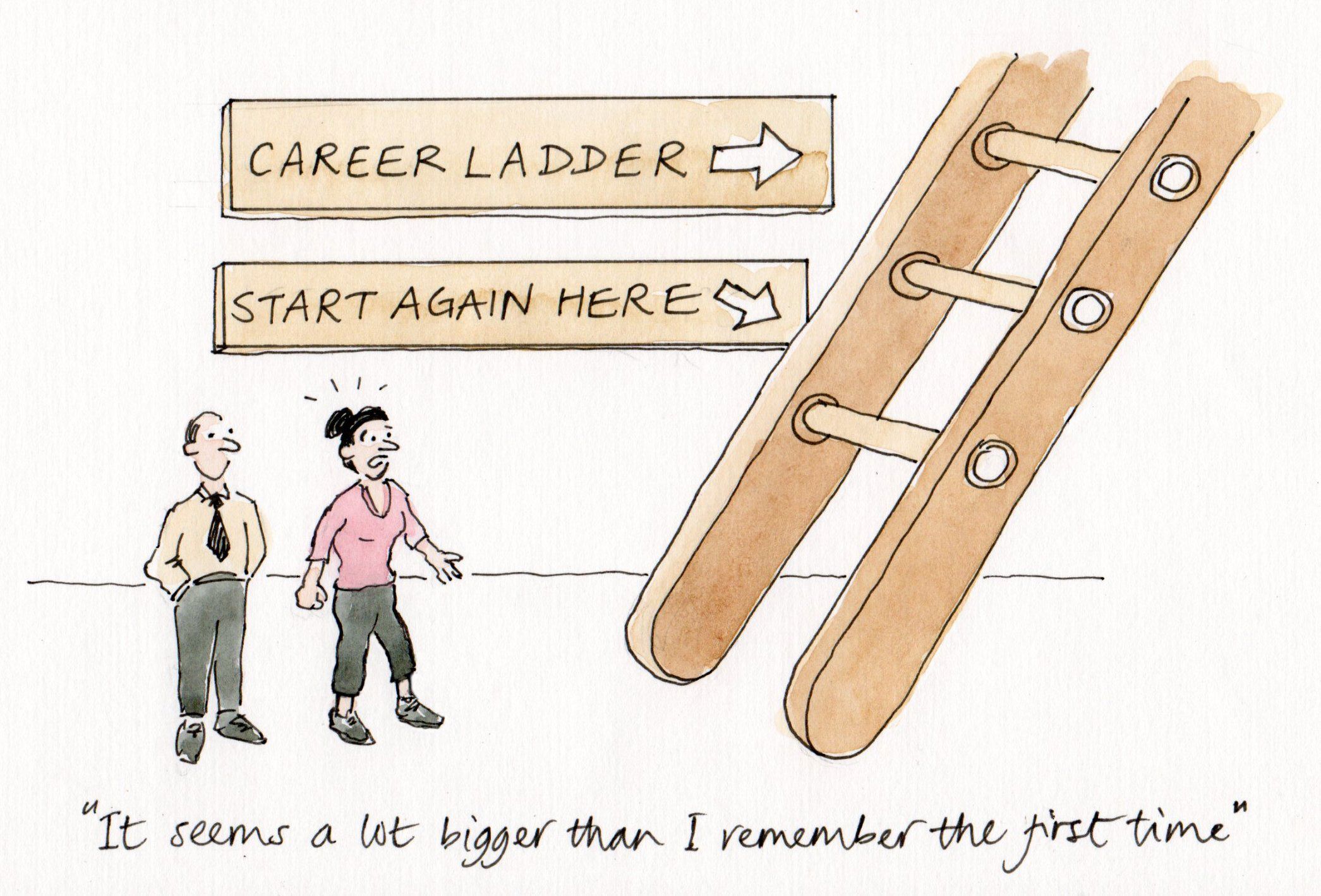
11 career steps to a second career

August 5, 2013 By //  by DigitalJenIPC

Cartoon 14 Career Ladder

Fancy a second career different to your first? Many people fall into their first career, so it’s not surprising that more and more people are seeking a second career.

It can feel like a void when you change career, so it helps to have career steps to pave the way to your future.

Last week I did telephone coaching sessions to prepare two clients practically and mentally in their decision to negotiate a career step in their career change.

Client A is working full time and wants to change career direction and needs to be able to do an internship in the Autumn in their new area of work. They broached the subject of a sabbatical with their line manager with 3 options. It went really well and it is looking like a ‘yes’ to the sabbatical.’

Client B’s current role is being made redundant and they have been offered alternative roles but are concerned that this is not the right choice for them and they want to take the opportunity to do something different. Result – they successfully negotiated redundancy.

Coaching is really useful to help people to prepare and think through different options, make the right decision for you and communicate this in the best way to the target audience to achieve your desired outcome.

What could your stepping stone be to a different career? In future, work will become much less guaranteed and more transient with temporary assignments the norm for many of us, so this is an important thing to start thinking about.

Here are 11 possible stepping stones to pave the way for your new career:

1. Get made redundant and get a lump sum
2. Take voluntary redundancy and get a lump sum
3. Take a sabbatical
4. Take a career break
5. Switch from working full time to part time with your current employer
6. Leave your current employer and do contracting/interim work in the same industry/profession
7. Switch from full time employment to freelance project work in the same sector
8. Help out a friend in their business to gain new experience
9. Save up a cushion to dedicate to creating your career change
10. Do some volunteering
11. Fund your own retraining while still self-employed to broaden your skills, qualifications and choices

What other career steps would you add?

If you are thinking about career change, start the career steps to your new career this August.

For more insights and tips, follow us on Twitter:
https://twitter.com/talentliberator

Have you downloaded our free PDF to identify what your transferable skills are? Click on this link: http://careerstrategies.co.uk/changingcareersreport/

Filed Under: Career change Tagged With: Career change, career steps, energise, new career, rachel brushfield, second careers, talent liberator

Is a new career like a marathon?

July 29, 2013 By //  by DigitalJenIPC

623-01741727

I was chatting to a potential client last week who runs marathons. How they approached the 26 mile race reminded me of people who want a new career.

Many people want a new career, but it feels so huge and overwhelming that they never start.

If a marathon runner dwelled on the fact that they had to run for 26 miles, they would probably be put off doing marathons, whereas if they focus on 1 mile at a time, the race is far less daunting.

The same is true with a new career – it is a big decision and best tackled one step at a time.

The world is changing so fast, taking this approach with a new career is wise because you can review your strategy as you go along, just as a marathon runner would depending on the weather conditions, speed of the other runners, terrain etc.

How do you perceive a new career? What would be your first step?

August is a great time to start so you are prepared and ready in September.

To follow us on Twitter, click on this link:
https://twitter.com/talentliberator

Free Skills download:
http://careerstrategies.co.uk/changingcareersreport/

Read about two of our clients who created a new career:

Persistence to realise a career vision (Anna)
http://archive.constantcontact.com/fs042/1102862873131/archive/1106812347557.html

Starting a charity (Mary)
http://archive.constantcontact.com/fs042/1102862873131/archive/1106770362344.html

Filed Under: Career change Tagged With: a new career, career, Career change, career change tips, energise, rachel brushfield, talent liberator

Does your job ever make you weep?

July 24, 2013 By //  by DigitalJenIPC

Fed up man


I had an e mail this week from a potential client. I bet some of you can relate to what they said in their e mail or know someone it reminds you of:

“I am not happy in my current role and have for a while been thinking about what to do next. I know I do not want to stay in my current profession but in truth do not know what I want to do. This has been brought to the fore last week as I was put at risk of redundancy by my employer although there are a number of new posts that I could apply for and I think the expectation is that I will take one of these. This would be the easy option but I think will still leave me wondering ‘what if?’

‘What if?’ is a hard one isn’t it? It is in the future and an unknown quantity, so you don’t know if you will wish you had done something differently and have regrets or not.

This week I have worked with a number of new clients who hate their job/career. It is not uncommon for them to feel depressed and sometimes they cry in the session because they are so fed up of feeling fed up.

It is not surprising is it? As a metaphor, it is a bit like a plant trying to grow without any sunshine and in the wrong environment for it to thrive.

When we first start working together, we do a session in two hours which helps them to identify what motivates them and what is important to them (their values). They quickly see that their job or career is not giving them these things. You can see the light bulb go on. Sometimes moving department or company can make all the difference, but for many changing career is what they choose to do.

Career change is a big decision so we tackle it thoroughly, strategically and practically.

Who do you know who is wondering ‘What if?’ It is never too late to change track, get on the right path and have more career fulfillment.  Summer is a great time to do the career change programme when the pace of life and work is a little less frenetic.

Here are a couple of examples of career change:

Anne

http://archive.constantcontact.com/fs042/1102862873131/archive/1108092201346.html

Duncan

http://archive.constantcontact.com/fs042/1102862873131/archive/1106786590378.html


For more insights and tips, follow us on Twitter:
https://twitter.com/talentliberator

Filed Under: Career change, Uncategorized Tagged With: career, Career change, careers advice, energise, new career, rachel brushfield, talent liberator

  • « Go to Previous Page
  • Go to page 1
  • Interim pages omitted …
  • Go to page 5
  • Go to page 6
  • Go to page 7
  • Go to page 8
  • Go to page 9
  • Go to page 10
  • Go to Next Page »

Primary Sidebar

Sign Up for Our Newsletter

Privacy by SafeUnsubscribe

Looking for something?

  • Being
  • Career agility
  • Career capital
  • Career change
  • Career coaching
  • Career fulfilment
  • Career prospects
  • Career satisfaction
  • Career strategy and planning
  • Change and uncertainty
  • Clarity
  • Confidence
  • Contracting and interim
  • Creativity
  • Diversity & inclusion
  • Emotonal intelligence
  • Employee engagement
  • Employment law
  • Entrepreneurial
  • Evolving a business
  • Fear
  • Flexible working
  • Freelance
  • Future-proof your career
  • Goals
  • Guest blog portfolio career
  • Habits
  • Happiness
  • Health
  • Hobby becoming a business
  • Interviews
  • Learning
  • Managing emotions
  • Marketing and selling
  • Money and abundance
  • Motivation
  • Networking
  • New year
  • NLP
  • Optimism
  • Performance
  • Personal brand
  • Personal development
  • Portfolio career
  • Productivity
  • Redundancy
  • Reflection
  • Relationships
  • Resilience
  • Retirement
  • Returners
  • Second careers
  • Self employment
  • skills
  • Small businesses
  • Social business
  • Social media
  • Starting a business
  • Stress
  • Success at work
  • Supporting our network
  • Talent management
  • Thought leadership
  • Transferable skills
  • Uncategorized
  • Unretirement
  • Vaues
  • Women
  • Work
  • Work life balance
  • Work trends
  • Working mothers

On Twitter

Twitter Sent An Error: Could not authenticate you.
  • Facebook
  • LinkedIn
  • Twitter
  • Website Terms & Conditions
  • Cookie Policy
  • Privacy Policy

+ 44 (0) 845 22 55 010
rachel@inspiringportfoliocareers.com

Copyright © 2026 Inspiring Portfolio Careers from Energise, The Talent Liberation Company · Site Design by DigitalJen ·

We use cookies to ensure that we give you the best experience on our website. If you continue to use this site we will assume that you are happy with it.