• Menu
  • Skip to primary navigation
  • Skip to secondary navigation
  • Skip to main content
  • Skip to primary sidebar

Inspiring Portfolio Careers

From Energise - The Talent Liberation Company

  • Home
  • You
    • Why choose a portfolio career?
    • Who is a portfolio career for?
    • What is a portfolio career?
    • When is it time for a portfolio career?
  • Us
    • Why choose us?
    • What is our approach?
    • What are our values?
    • Who are our clients?
  • Services
    • On-line programmes
    • Career Coaching
    • E-Course
    • Skills CV Design
    • Marketing Mentoring
    • Personal Branding
    • Booking
  • Inspiration
  • Testimonials
  • Blog
  • Contact Us
  • Website Terms & Conditions
  • Cookie Policy
  • Privacy Policy
  • Home
  • You
    • Why choose a portfolio career?
    • Who is a portfolio career for?
    • What is a portfolio career?
    • When is it time for a portfolio career?
  • Us
    • Why choose us?
    • What is our approach?
    • What are our values?
    • Who are our clients?
  • Services
    • On-line programmes
    • Career Coaching
    • E-Course
    • Skills CV Design
    • Marketing Mentoring
    • Personal Branding
    • Booking
  • Inspiration
  • Testimonials
  • Blog
  • Contact Us
You are here: Home / Archives for DigitalJenIPC

DigitalJenIPC

Career cul de sac or crossroads?

December 22, 2012 By //  by DigitalJenIPC

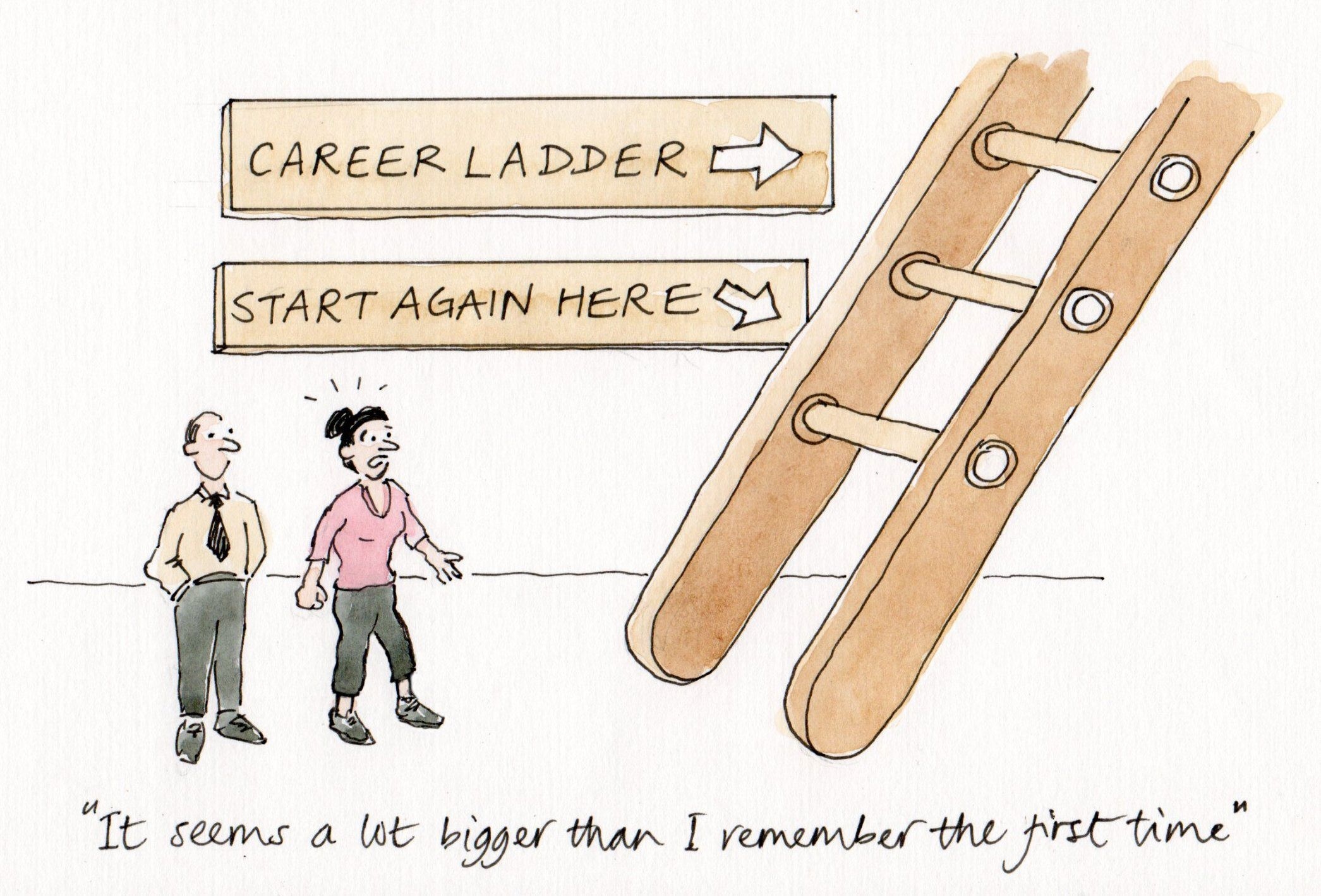
Career Ladder cartoon

How’s your career?

Making time to reflect on your career and take a step back can be hard in a busy world.

It is important to do this, because even in uncertain times, you need to create a career strategy and plan. It is a bit like having a horizon towards which you sail, but you might have to tack sideways to reach your destination. You might encounter a storm or two on the way, or head into port for a while to service the boat or do some training for the new digital equipment. Or you might decide to adjust your compass, change your career horizon, and head in a different direction altogether.

Here are some self-reflective questions to reflect on your career.

  • What have I achieved this year to be proud of?
  • What has worked less well this year and what have I learnt?
  • What needs to change to be fit for purpose for a prosperous and satisfying future career?
  • How much do I really understand my employer/client needs and priorities and how can I understand them better?
  • What is resistance to change costing me?
  • What’s working well and what’s working less well?
  • Where can I improve efficiency and be more productive?
  • How motivated and engaged about my career am I feeling?
  • What training do I need to be fit for purpose with the changing work market?
  • What goals do I want to achieve next?
  • What’s stopping my career fulfillment and what can I do about it?
  • What are my values and to what extent is my career aligned with them?
  • What’s my career plan and who or what can help me to make it happen?

For insights about the changing world of work, why not follow us on Twitter:@talentliberator

Wishing you success and career fulfillment. Let us know how we can help you on your journey.

 

Filed Under: Career change Tagged With: career, Career change, career satisfaction, change, energise, new year new career, New year resolutions, rachel brushfield, reflection, talent liberator

Comfortable or uncomfortable career change?

December 8, 2012 By //  by DigitalJenIPC

Path through green grass

Career change is a big change affecting lots of things and often people get stuck for different reasons. Change and clarity about the change need to be created at a number of levels and ‘stuckness’ for a short or longer time can occur at any of these; vision; identity; values; beliefs; capabilities; behaviours; environment.

Vision: The future vision you have for your second career is often very different from your first career or the vision your parents/guardians had for you. Many people fell into their career, or received no/poor advice, so may not have had a vision at all. Creating a vision – the horizon towards which you are always moving towards is crucial, especially through challenging uncertain times and knockbacks.

Identity: Identity – ‘who am I’ in the world of work and society is crucial to how we feel. Having a place in the world and feeling connected is an inherent part of being human. Life is full of job titles and ‘what do you do?’ questions when you meet people in a social or business context.  “I am a senior manager” or “I am a doctor’ or “I am a lawyer” for example can be difficult to let go of unless you have thought through the new you and feeling comfortable and congruent with what you say when asked “What do you do?”

Values:  What is important to you is an inherent part of the desire for career change – your values. Poor career fulfilment is caused by people’s values not being honoured by their work. If you love innovation, but your boss or employer loves tradition, this is a mismatch and causes dissatisfaction. Making decisions consciously and intuitively about your career or job options around your values is essential. Values also affect what type of employment or self-employment is right for you.

Beliefs: ‘I must work 9-5’ or ‘I need to strive and get to the top of my profession’ or ‘it is impossible to earn a living doing what I love’ are often beliefs that cause people to be stuck. Often the beliefs we have about work are not even ours, but ones that we pick up from society, the media or parents e.g. ‘self-employment is risky’ or ‘a secure job with a career path is essential.’

Capabilities: Everyone is talented in their own unique way but many people find it hard to identify their capabilities and skills and see where else they are useful. If you cannot see where you are moving to, it will be unlikely that you will step off into what can feel like a void or abyss!

Behaviours: Proactivity and self-belief make a huge difference to making a career change, career success and career adaptability. Doing nothing is the easiest behaviour to choose but then nothing changes. Making a decision causes stress and anxiety, magnified in uncertain times and it is human nature to avoid stress and fear. Acknowledging these and keeping on moving forward makes uncomfortable change feel more comfortable.

Environment: The environment in which we thrive can be really important for career fulfilment; being out of the office, or having music on in the background rather than silence. Not being clear what environment energises and nourishes you can cause an impasse.

At any point in a career transition, you can get stuck at one or more of these levels. To create a successful career change, you need to think through all these areas; vision; identity; values; beliefs; capabilities; behaviours; environment.  This is something that it can be hard to do yourself, as you are too close to yourself.

Where are you stuck? What advice/experience can you share to help people to move forwards? A career coach helps you to become unstuck, like a plumber helps you unblock a drain so things flow free again.

For more insights and tips, follow us on Twitter: @talentliberator

PS Did you know we do career coaching gift vouchers? They make a great thoughtful and practical birthday, Christmas or leaving present.


Filed Under: Career change Tagged With: Career change, career transition, change, energise, new career, rachel brushfield, talent liberator

As clear as mud?

November 30, 2012 By //  by DigitalJenIPC

My clients inspire me so much and a coaching session this week inspired me to write this blog, as this blog’s theme is a common one to arise.

A new career involves a lot of new and, for many, challenging aspects:

  • Learning the language of a new market
  • Having to market yourself
  • Creating a different network
  • Asking for help, advice and introductions

This can be overwhelming and daunting; you can only know what and who you know. So why are career choices so overwhelming?

  • Where to look?
  • Who to ask?
  • What to ask?
  • When and how to tackle?
  • How to find the time?
  • Which to choose?

When people feel overwhelmed and daunted, the easiest thing to do is nothing because of lack of time and avoiding stress.

So what is the best way to tackle finding out about potential careers which suit your experience and skills?

I remember in the early days of my business, over 14 years’ ago, I used to put ‘call contacts’ on my ‘to do’ list. However, I seemed to never get around to doing it.

I worked out that there were various reasons why I wasn’t phoning my contacts;

  • I would rather write an article or blog
  • I felt like I had too many so didn’t know where to start
  • I wasn’t clear about who to phone or why
  • I was worried about disturbing and annoying busy people at work
  • I like peace in my office so was projecting my preference onto them
  • I am better at phoning my contacts to help other people than for my own benefit

Having established this, I felt a bit clearer, but what next?

I spent some time focusing on what my objectives were i.e. my purpose for phoning my contacts:

  • To see how they were
  • To keep top of mind
  • To get an update on their needs
  • To arrange to meet
  • To share what I had been doing
  • To find out specific information e.g. when their financial year was, who was responsible for a specific area

Once I had broken down the task, it felt like the mud was starting to clear a bit.

For people who are considering a different career or to set up a business, getting really specific and explicit can reduce the overwhelm so the brakes are taken off taking action.

A list of questions are a good starting point and asking just one of each person can feel more comfortable:

Questions to start exploring with might be:

  • Who are the experts in this field?
  • What are relevant networks?
  • What web sites should I look at that have useful information?
  • What is their advice from their own experience?
  • Who do they know who they can introduce me to?

Analysing and breaking down what can feel like a huge undertaking into small, simple, clear bite size questions and tasks can make it feel do-able rather than impossible.

Getting some insights and information gives a sense of progress and reward and helps the mud start to clear as well as creating motivation and energy to take more action.

For more tips and useful information to help you liberate your talent, follow us on Twitter:

https://twitter.com/talentliberator

Filed Under: Uncategorized Tagged With: Career change, career choices, energise, overwhelm, rachel brushfield, second careers, talent liberator

Are you a silly sausage?

November 24, 2012 By //  by DigitalJenIPC

I had a bit of a panic this week.

You know those times when you have a fast worried inner rant with yourself?

I had gone to an excellent talk about career change where the presenter had shared about the process of career change and how people become stuck, going round and round in circles.  Oh no, I thought to myself! No-one will actually pay for support if they know how to do it themselves and they can buy a book, download a free e book from the web or get help from a friend/relative.

There are a lot more competitors on the market now, which is the same for many people, so it is harder to create awareness. I was doubting my own uniqueness, something which I tell my clients not to do. Doh!

Yes, you silly sausage, there is lots of free stuff out there, but it cannot do what a good career coach brings to the process.

Below are general things that any career coach brings:

  • Time in the diary in a busy world to focus on creating change
  • A witness of the client’s expression of the desire to change
  • A step by process which helps make it happen
  • Sharing the blocks to progress which often clients cannot see as they are too close to their situation
  • Skill at listening, questioning and reflecting back key themes
  • Exercises to create awareness and clarity
  • Objectivity which someone close cannot give, because they have their own agenda and fears
  • Introduction to new contacts
  • Help marketing yourself

The presenter at the talk shared the key blocks to successful career change:

  1. Ping ponging away from avoidance of fear and anxiety about change and making a mistake and towards the desire for something compelling and back again
  2. Short term focus
  3. Linear thinking
  4. Choice overload of ideas creating overwhelm and inaction

Can you relate to these?

I felt so much better then.  Rachel, you silly sausage, remember this next time you have a panic:

  1. Courage to embrace uncertainty –  how many people take 6 months out unpaid to look at market trends to ensure their business is on track, develop skill in a new area  from a standing start (talent management) and read as many research reports as you do?
  2. Long term focus – how many people buy a house with a bus stop in their 40’s thinking ahead to when they are in their 80’s and may not have a car?
  3. Non-linear mind – how many people have your energising connecting mind, that is unique in its ability to spot insights, make connections and come up with ideas that people simply cannot see themselves? (21 in a session is my record so far)
  4. Focus – how many people have a laser focus and tools to work through and narrow down options as much as you do?

Oh yes. Fair point. And don’t forget about your 900+ quality connections on LinkedIn and huge toolbox of tools and tips. Oh yes, Forgot about that. Panic over.

So don’t doubt yourself. You are unique. Competition is increasing but you can develop your skills to build your competitive advantage and make your career change happen successfully, even in a downturn.

For more useful tips, follow us on Twitter @talentliberator

Filed Under: Career change Tagged With: Career change, energise, fears about change, overcoming career change fears, process of career change, rachel brushfield, talentliberator

Are you in love with your job?

November 13, 2012 By //  by DigitalJenIPC

Do you love your job? If not, what are you doing about it? I often find that if people aren’t sure what to do, they do nothing, which leads them, well nowhere.

You can make small changes where you are, change your attitude to your current role, or plan a carefully thought out and well researched move elsewhere.

Here are 15 reasons why I LOVE my job:

  1. My job is to help people find work they love and which fits them perfectly so they feel more fulfilled and are more productive
  2. I meet some really interesting people and learn from them
  3. I love asking questions and helping people discover insights and clarity
  4. I feel inspired
  5. I can honour my values and be me
  6. I feel authentic as I have successfully changed my own career many times so I know it’s not too scary
  7. I get paid to do what I love
  8. I feel ‘in-flow’ and alive
  9. I see my clients become more happy, fulfilled and confident
  10. I get to write which I love
  11. It combines all my experience and skills
  12. I like helping people
  13. I am a natural connector of resources and useful information
  14. I love trends and research
  15. I am passionate about people having unique talents and realising their potential

Get in touch if you would like to enjoy your job more than you do and are open to support.

To follow us on Twitter, @talentliberator

Filed Under: Career change Tagged With: career happiness, energise, fulfilling work, love work, rachel brushfield, talent liberator

Are you oven ready?

November 2, 2012 By //  by DigitalJenIPC

Employers are looking for ‘oven ready’ candidates. People who will slot perfectly, meet the job specification completely, – a ‘round peg into a round hole’. They may say they want to try new approaches, but often the behaviour and action does not match the words. If you are an oval or square peg, you may get overlooked which can be very frustrating.

Oven readiness or ‘a tight fit’ is something risk averse employers look for when recruiting; competences, experience and values.

Nervous to increase headcount, going for a safe bet and a tight fit re skills and experience reassures them. When new thinking is needed to solve old business problems, why do they take this attitude and if you think you are a good fit for the job specification, how can you get your foot in the door and persuade them to think differently?

Here are factors affecting their mindset re whether someone meets the job description:

  • Employers are more risk averse than they were and would rather delay recruitment for the right person
  • It is a buyer’s market – supply outstrips demand so the employer holds the power
  • Employers lack time, with less people doing more work, so from a decision fatigue perspective, it is easier to make an obvious ‘oven ready whip it out of the packet you fit in our box’ decision than go for an innovative approach
  • It takes time to understand a new sector, even if there are similarities, and line managers lack time to get new recruits up to speed
  • Training and development budgets are being cut, with more focus on select groups e.g. high potentials, so investing in developing a new recruit’s skills is not ideal, ‘oven ready’ is more cost effective
  • The brain sorts for similarity – it is how neural pathways work, so same market experience = similarity

If changing sectors is your only option because your sector is shrinking or something  you aspire to in order to develop your career, here are some tips to make you fit the job description:

8 tips to help overcome the oven ready mentality 

  1. Attend industry/special interest networks, seminars and conferences on-line and off line to meet new contacts and understand the issues
  2. Show you understand your target market through the language you use
  3. Get warm introductions through your LinkedIn network
  4. Write a thought leadership article demonstrating your understanding of your target market’s issues and challenges
  5. Think about and share the benefits of your different experience to the target market/employer in helping them achieve their goals and address business challenges
  6. Define your personal brand so the value you bring is clear and compelling
  7. Do an internship or voluntary work to get experience of your target sector
  8. Help them to see the similarity between the experience you bring and their market

Is persuading a sector to embrace you when your background is different possible?

Yes. My background is FMCG (fast moving consumer goods) and the communication industry and the legal profession is now my main market even though I am not a lawyer and have never worked in a law firm. The legal profession is one of the most resistant markets to outsiders there is, so it is possible.

If you are looking to re-position yourself or go for a radical career change, why not get in touch?

Read our bulletin on Decision fatigue:

http://archive.constantcontact.com/fs042/1102862873131/archive/1111115019111.html

Filed Under: Career change Tagged With: energise, job description, job hunting, jobs, rachel brushfield, recruitment, switching sectors, talent liberator

What’s your personal brand?

October 28, 2012 By //  by DigitalJenIPC

It is important to have a niche to build your personal brand, but how do you know what niche to choose so that it motivates you and there is enough of a market for you to get your teeth into? Many people worry about narrowing down what they offer, fearful that they will limit themselves or say no to opportunities and regret it. Trying to appeal to everybody means that you end up appealing to nobody.

The internet means that the whole world is your potential market, so having too broad an offer of services or target customers can mean that you waste time and marketing budgets and achieve little, and do not build your personal brand.

Here are 10 questions for you to think about your personal brand:

  1. What words do people who know you well use to describe you?
  2. What are you really good at that you take for granted?
  3. What kind of problems do you really enjoy solving?
  4. What specific group of people do you feel most passionately about helping?
  5. What challenge have you personally overcome that you can now help others with?
  6. What type of project, if you could only choose one, would you love to tackle?
  7. What would be your dream role and why?
  8. Imagine getting to the end of your life and looking back. What would you like to be remembered for?
  9. What themes consistently come up in performance appraisals/client testimonials about you?
  10. What 2 words best sum up the gift you give to others?

What questions would you add to help to help build your personal brand?

Everything is changing fast, so plan time at least every three months to review and update your personal brand.

To follow our tweets on Twitter, follow us: talentliberator https://twitter.com/talentliberator

Filed Under: Personal brand Tagged With: build your personal brand, creating your personal brand, energise, how to market myself, personal brand tips, rachel brushfield, talentliberator, your personal brand

Armbands or rubber ring?

October 19, 2012 By //  by DigitalJenIPC

I was reflecting on what stops people from jumping ship, i.e. changing career. Here are the 11 most common ones from working with many different people:

  1. Lack of confidence/self-belief
  2. Not aware of what skills and qualities they possess
  3. Don’t understand how social media is useful
  4. Perceived insecurity of making a change
  5. Lack a network
  6. Don’t know where/how to find out about different careers
  7. Dislike networking
  8. Other people’s fears e.g. loss of status
  9. Reluctance to ask for help
  10. Worry about being rejected
  11. Dislike of change

What would you add? What would you recommend to help people tackle them?

Filed Under: Career change Tagged With: Career change, energise, fear, rachel brushfield, talent liberator

Success at work?

October 13, 2012 By //  by DigitalJenIPC

I had a lovely e mail from a client this week who had left their job because they couldn’t stand it anymore, and were loving their new role, working 3 days a week in a culture conducive to their values and feeling they were making a difference and living life ‘on purpose’. To quote their words:

“I earn less than I did in my first job out of university but at the moment all the other things more than compensate.”

Their e mail made me think. What is this obsession we have with a bigger, better job title, house, car etc. when often, from the work I do with people, I see that it makes them miserable, endure lots of stress, have no time to see their kids, and exist in environments that do not fit their values?

It reminded me of a brilliant book I read a while back, ‘Enough’ by John Naish – really recommend it.

http://www.amazon.co.uk/Enough-Breaking-free-world-more/dp/0340935901

In a week of news about rising fuel costs and food prices, in a world where people choose to bet on food prices, from which they could get rich but cause people in poor countries to starve, it got me thinking about success.

The dictionary definition of success is: ‘The achievement of something desired, planned, or attempted.’

What does success at work mean to you?

  • Getting to Board level – the ‘C’ suite
  • Work that honours your values
  • Flexible working
  • Minimising stress and politics
  • A role that plays to your strengths
  • Freedom & autonomy
  • Winning an award
  • Being able to be yourself at work
  • A culture/company that matches your values
  • Being acknowledged for your unique contribution at work
  • Having a job in the downturn

What does ‘success at work’ mean to you and are you getting it?

If not, what are you going to do about it?

Follow us on Twitter @talentliberator

Filed Under: Uncategorized Tagged With: achievement, rachel brushfield, success, success at work, talentliberator

20 career change tips from people who have

October 4, 2012 By //  by DigitalJenIPC

Career change can feel daunting at the best of times, let alone in a downturn. What better way to get tips than from people who have already changed career. Here are 20 tips from people who have successfully made a career change.

  1. Use your network to get a warm introduction to the decision maker
  2. Anything is possible if you desire it enough but it takes planning and realistic expectations
  3. Make time to do research and understand a new career and sector
  4. Think about what you really want and if it is to do work you are passionate about or just have another job
  5. Evaluate your short, medium and long term financial commitments
  6. Evaluate your current finances for ‘survivability’
  7. Think about what you would do in a ‘worst case’ situation
  8. Don’t put yourself in ‘a box’ – open your eyes to new opportunities
  9. Believe in yourself and stay determined
  10. Research new career choices so you understand barriers to entry, competition and future career prospects
  11. Check whether you are likely to face the same challenges and frustrations in your new career as your old career, so ‘jumping from the frying pan into the fire’
  12. Unless you have money saved up and you can afford to take time off, don’t leave your job with nothing to go to until you have thought everything through
  13. Be clear if you are running away from or towards something
  14. Analyse your current position and why you want to leave it
  15. Know your strengths and weaknesses and what type of environment, work schedule and activities you like to do
  16. Think about what would make you happy, give you meaning and purpose and make you jump out of bed every day
  17. Remember that career change is a process
  18. Keep an open mind to what the future will hold and what unexpected opportunities may present themselves
  19. Make sure your desire to change your career is not projection of frustration in another area of your life e.g. personal relationship
  20. If you can, go indirectly to the decision maker and bypass HR who can have a ‘ruling out’ mentality, especially as they are overwhelmed by hundreds of CVs

With a busy job/life, all these things can be a lot to take in/make time for, especially as you are so close to yourself. That is why working with a career coach and strategist can help you to make it happen and give you support and practical advice in a safe setting and objective and confidential way. It is bit like having an event or wedding planner help you. They support you to create a great and positive result.


Filed Under: Career change Tagged With: a career change, Career change, career change after 50, career change help, change in career, energise, how to change career, midlife career change, rachel brushfield, talent liberator

  • « Go to Previous Page
  • Go to page 1
  • Interim pages omitted …
  • Go to page 8
  • Go to page 9
  • Go to page 10
  • Go to page 11
  • Go to page 12
  • Interim pages omitted …
  • Go to page 20
  • Go to Next Page »

Primary Sidebar

Sign Up for Our Newsletter

Privacy by SafeUnsubscribe

Looking for something?

  • Being
  • Career agility
  • Career capital
  • Career change
  • Career coaching
  • Career fulfilment
  • Career prospects
  • Career satisfaction
  • Career strategy and planning
  • Change and uncertainty
  • Clarity
  • Confidence
  • Contracting and interim
  • Creativity
  • Diversity & inclusion
  • Emotonal intelligence
  • Employee engagement
  • Employment law
  • Entrepreneurial
  • Evolving a business
  • Fear
  • Flexible working
  • Freelance
  • Future-proof your career
  • Goals
  • Guest blog portfolio career
  • Habits
  • Happiness
  • Health
  • Hobby becoming a business
  • Interviews
  • Learning
  • Managing emotions
  • Marketing and selling
  • Money and abundance
  • Motivation
  • Networking
  • New year
  • NLP
  • Optimism
  • Performance
  • Personal brand
  • Personal development
  • Portfolio career
  • Productivity
  • Redundancy
  • Reflection
  • Relationships
  • Resilience
  • Retirement
  • Returners
  • Second careers
  • Self employment
  • skills
  • Small businesses
  • Social business
  • Social media
  • Starting a business
  • Stress
  • Success at work
  • Supporting our network
  • Talent management
  • Thought leadership
  • Transferable skills
  • Uncategorized
  • Unretirement
  • Vaues
  • Women
  • Work
  • Work life balance
  • Work trends
  • Working mothers

On Twitter

Twitter Sent An Error: Could not authenticate you.
  • Facebook
  • LinkedIn
  • Twitter
  • Website Terms & Conditions
  • Cookie Policy
  • Privacy Policy

+ 44 (0) 845 22 55 010
rachel@inspiringportfoliocareers.com

Copyright © 2026 Inspiring Portfolio Careers from Energise, The Talent Liberation Company · Site Design by DigitalJen ·

We use cookies to ensure that we give you the best experience on our website. If you continue to use this site we will assume that you are happy with it.