• Menu
  • Skip to primary navigation
  • Skip to secondary navigation
  • Skip to main content
  • Skip to primary sidebar

Inspiring Portfolio Careers

From Energise - The Talent Liberation Company

  • Home
  • You
    • Why choose a portfolio career?
    • Who is a portfolio career for?
    • What is a portfolio career?
    • When is it time for a portfolio career?
  • Us
    • Why choose us?
    • What is our approach?
    • What are our values?
    • Who are our clients?
  • Services
    • On-line programmes
    • Career Coaching
    • E-Course
    • Skills CV Design
    • Marketing Mentoring
    • Personal Branding
    • Booking
  • Inspiration
  • Testimonials
  • Blog
  • Contact Us
  • Website Terms & Conditions
  • Cookie Policy
  • Privacy Policy
  • Home
  • You
    • Why choose a portfolio career?
    • Who is a portfolio career for?
    • What is a portfolio career?
    • When is it time for a portfolio career?
  • Us
    • Why choose us?
    • What is our approach?
    • What are our values?
    • Who are our clients?
  • Services
    • On-line programmes
    • Career Coaching
    • E-Course
    • Skills CV Design
    • Marketing Mentoring
    • Personal Branding
    • Booking
  • Inspiration
  • Testimonials
  • Blog
  • Contact Us
You are here: Home / Archives for career pivot

career pivot

Transferable skills – where next? Part 3.

April 7, 2021 By //  by Rachel Brushfield

This is part 3 of a 4 part blog series about transferable skills.

This blog is an extract from section 6 of our Energise career e course: https://www.inspiringportfoliocareers.com/e-course/

Read part 1: https://www.inspiringportfoliocareers.com/transferable-skills-where-next-part-1/

Read part 2: https://www.inspiringportfoliocareers.com/transferable-skills-where-next-part-2/

How can you use your best skill in new contexts?

People often don’t know how the skills they use in one context could be useful in another context, job or career. We can only know what we know and it can be hard to be clear about what other career options are open to us.

One of the things that I do with my clients is help them understand how their minds work and the steps they take with solving a problem for example; then identify other contexts where this approach could be useful. It is amazing how skills are transferable to completely new areas.

Examples of skills that can be transferred:

  • From sales & marketing property to sales & marketing hotels as a place to stay
  • From insights about consumers to insights about people
  • From employed PA to self-employed virtual PA

From sales and marketing property to sales and marketing hotels as a place to stay

One participant of our Energise ‘Steer your career’ workshop had been made redundant from her job in the property industry, selling houses. At that time, the prospects of finding another similar job were almost non-existent. We helped her to see how her skills of sales, marketing and dealing with customers were very transferable. She reshaped her CV and achieved a fantastic prestigious job for Malmaison hotels, broadening her experience and marketability.

She missed the property world, so went back to it when more jobs became available, so her career revitalisation was temporary based on market conditions.  As a result of working with us, she gained an increased awareness of herself, her values, her skills and motivations, so she knew that property was where her heart lay.

From insights about consumers to insights about people

Insight mining is one of my key skills and it is a combination of observation, analysis, making connections and thinking laterally. In the past, I worked as an account planner in the communication industry and a key part of my job was reading research, looking at trends and analysing information to mine insights that would help brands and companies to achieve a competitive advantage.

I now use those same skills with my clients in career revitalisation. Insights about themselves and what makes them unique, insights about what target employers or customers want, insights about how they can be different from their competitors.  Different context, same skill.

From employed PA to self-employed virtual PA

Many companies have been making PAs redundant, partly to reduce costs to companies, but also because computers and technological advances make it easy for management to do their own typing and administration.

This is an example of huge change to what used to be an established career for life. At the same time as demand for this type of job is shrinking, more and more people have been setting up their own business. If you own a business and have no staff (usual when you start) it is hard to do everything yourself and makes a lot of sense to focus on what you are really good at. Having a virtual PA makes good sense.

The number of hours in each working day is finite, so it makes sense to be smart and use them wisely. If I am spending time in customer care lines to renew my domain name, not only am I feeling frustrated, but also I am not using my time in the best way which plays to my strengths!

Read my article about having a virtual PA on LinkedIn: https://www.linkedin.com/pulse/whos-looking-after-you-rachel-brushfield-the-talent-liberator/

What next?

If you are at a major career crossroads and thinking about changing career direction, becoming self-employed or developing a portfolio career, we can help.

Why not get in touch to arrange your free no obligation meeting?https://www.inspiringportfoliocareers.com/contact-us/

Save the dates! Coming soon.

Energise seminars to help you to market yourself.

10-12 Tuesday 11 May 2021 on Zoom: “Why me? What value do you bring?” https://www.eventbrite.co.uk/e/marketing-seminar-why-me-what-value-do-you-bring-tickets-149507654419

10-12 Tuesday 15 June 2021 on Zoom. “Marketing me: Proactive marketing.”

Contact us to find out more: https://www.inspiringportfoliocareers.com/contact-us/

Filed Under: Transferable skills Tagged With: career pivot, portfolio career, portfolio careers, the talent liberator, transferable skills

Variety is the spice of life

February 14, 2021 By //  by Rachel Brushfield

Introduction

I have been running my own business Energise for over 24 years and have always enjoyed variety.

In 2011, I was lucky to read the book ‘The Shift’ by Lynda Gratton, a Professor at London Business School about changing work trends and what the world of work would be like in 2020.

I am so glad that I did, because having implemented its recommendations myself, I am now in a good position to help people at this challenging time in the world, with Covid-19 having accelerated a decade of change into 1 year.

What is a portfolio career?

A portfolio career is work/a career made up of multiple components, for example freelance work, a contract, a part time job, non-executive directorships, trustee and volunteering, rather than just having 1 job or running 1 business.

As a metaphor, a portfolio career is like choosing Dim Sum or Tapas in a restaurant, a variety of different dishes, rather than just one single main dish, giving you a variety of flavours and textures and a moreish combination.

Why are portfolio careers growing?

Portfolio careers have been growing for a while, because of 2 growing segments:

· The ‘want a portfolio career’ market – pre-retirees wanting a gentle ‘slope’ rather than a steep ‘cliff’ to retirement, and millennials (young workers) who have different career aspirations to previous generations.

· The ‘need a portfolio career’ market – this has grown massively because of the impact of Covid-19 on both the employed and self-employed sectors; shrinking markets, forced career change, reduced consultancy projects with greater competition, more people becoming self-employed, and a raised ‘bar’ of the standard required to secure a job or project.

How do portfolio careers vary?

Portfolio careers have been around for centuries – think holiday destinations with seasonal tourism, who need a different way of earning a living for the rest of the year.

Portfolio careers vary a lot, and they also change a lot!

They can be segmented into:

· Similar e.g. associate work with different companies

· Contrasting e.g. leadership coach and historical author

· Synergistic e.g. bee-keeper and dentist

A portfolio career isn’t the right career choice for everyone, so thinking it through carefully is essential. Working with an experienced career coach, specialising in portfolio careers can be invaluable.

A portfolio career is like a kaleidoscope.

You can adjust it and create new work patterns that suit you, as your needs change, and market trends shift.

Everyone is unique and so is each portfolio career!

What are the benefits of a portfolio career?

Benefits include:

· Variety

· More fulfilment and flexibility

· Constant learning

· Increased career agility

· Enhanced career resilience

· A future-proof career

· Reducing your career risk

What are the drawbacks of a portfolio career?

Drawbacks include:

· Constant change

· Less certainty and security than a traditional career

· Need to focus on trends and take stock regularly

· Must embrace marketing and networking

· Need to be super-organised

A portfolio career is like having a ‘safety net’.

Is it really a good idea to put all your career ‘eggs in one basket’ in an uncertain world?

What next?

To receive a free Energise report: ‘Discover Portfolio Careers’ including a free 15-question suitability questionnaire and/or to arrange your free 20-minute no-obligation meeting to explore whether a portfolio career is right for you, get in touch with Rachel Brushfield using this link: https://www.inspiringportfoliocareers.com/contact-us/

Recommended reading

Lynda Gratton ‘The Shift’ https://www.amazon.co.uk/Shift-Future-Work-Already-Here/dp/0007525850

Andrew J Scott + Lynda Gratton ‘The 100 year life’ https://www.amazon.co.uk/100-Year-Life-Living-working-longevity/dp/1472930150

Andrew J Scott and Lynda Gratton ‘The new long life’ https://www.amazon.co.uk/New-Long-Life-Framework-Flourishing/dp/1526615169/r

More about Energise

View Rachel Brushfield’s LinkedIn profile: https://www.linkedin.com/in/energiseliberateyourtalent/

Rachel Brushfield’s portfolio career

Inspiring Portfolio Careers https://www.inspiringportfoliocareers.com/

EnergiseLegal https://www.energiselegal.com/

Energise LLClub – Inspiring Portfolio Careers for Women Lawyers. https://www.llclub.org/

PWHub – Inspiring Professional Women – a network for senior employed women, all sectors, with quarterly CPD style events. Rachel is a co-founder. https://www.pwhub.org.uk/

This blog was originally a guest blog for Oxfordshire Business Community Network: https://oxfordbusinesscommunitynetwork.co.uk/blogposts/variety-is-the-spice-of-life/

Filed Under: Portfolio career Tagged With: career pivot, mike foster, portfolio career, portfolio careers, the talent liberator

Ready to be put ‘out to grass’? Or not! Part 2 of 2.

February 11, 2021 By //  by Rachel Brushfield

This is a 2-part blog by Peter Wilford about supporting Finance Directors (FDs) to consider about whether to retire or not, and how a portfolio career can be a good career choice for the pre retirement life stag.

This is part 2.

The rest of this blog is in Peter’s own words.

Read part 1

https://www.inspiringportfoliocareers.com/ready-to-be-put-out-to-grass-or-not-part-1-of-2/

How we help our clients

Success comes from a number of factors.

We help our clients to develop a Plan ‘A’, ‘B’ and ‘C’ for their job search and marketing activity.

Each plan is carefully crafted and the priorities assessed. 

This gives the Financial Director (FD) confidence that he / she is not putting all their career ‘eggs in one basket’. This is especially important for the uncertain times in which we live.

We coach them at every stage and act as a sounding board to keep them on track.

Career plan ‘A’, ‘B’ and ‘C’

Typically, career Plan ‘A’ might involve securing 2-3 pieces of paid consultancy work – often with an SME and where they were not likely to be seen as a threat to the incumbent CEO or Financial Director, but are able to add significant bottom line value. 

Career Plan ‘B‘ might be to focus on obtaining some interim work, particularly if they have already worked in a sector where interims are required and / or in a Senior Finance project role.

Career Plan ‘C’ might be to set up their own business and to create a web site and look at building a portfolio career to include typically:

  • non-executive director (NED) work
  • mentoring of younger finance professionals
  • voluntary work
  • paid consultancy projects.  

Also perhaps:

  • supporting a friend in their local area with their own business, to broaden their experience, leading to new future opportunities.

Age bias towards employing 50somethings

Securing a full-time role as a finance director (FD) in a large organisation in your 50’s is both difficult and extremely time consuming, unless you have a strong business network and very well-established head-hunter contacts.

Opportunities for an FD to get work more easily lie in the Small Medium Enterprise (SME) sector.

Finding your niche and how we help

One FD client, whose experience was both corporate and SME based, identified that his niche market was medical devices companies.

We worked together to write 2-3 compelling direct approach letters and he drew up a list of 50 SME organisations within an agreed geographical area.  

The letter was strong.

His value add proposition was convincing.

We coached him to be thoroughly interview prepared.

The result was a series of interviews with the MD / CEO of medical device companies.  

Proactively helping our clients

We are proactive in our approach, providing a bespoke service, unlike the large career management companies/outplacement organisations which can be ‘sausage machine’ in nature, and relying primarily on on-line career portals and a standardized approach. One size does not fit all.

Ways in which we help our clients

We go the extra mile at Energise for our clients. Ways in which we support them include:

  • Introducing them to relevant contacts in our own networks
  • Encouraging them to adopt a proactive approach to marketing, often in new areas and outside their comfort zone
  • Getting them to think ‘outside of the box’, for example to approach their Professional Institute e.g. ICAEW for possible mentoring
  • Encouraging them to attend industry conferences to broaden/widen their network
  • Sharpening up their technical skills
  • Pointing them to non executive director (NED) membership organisations.
  • Invited them to our local Institute of Director (IoD) group
  • Introducing them to local employers
  • Helping them build up their lists of head-hunters and to learn how to manage these conversations to the best effect

The result

All our clients have now been either placed or are enjoying a new phase of their working life.

Some have been introduced to our Independent Financial Advisor (IFA) contacts for fresh support with financial planning. 

Several have kept in touch.

Our clients have told us that they would not have known what to do without our help, coaching, senior experience and reassurance.

More

‘The 100-year life’ by Lynda Gratton and Andrew J Scott: http://www.100yearlife.com/

‘The new long life’ by Lynda Gratton and Andrew J Scott: https://thenewlonglife.com/

‘Future skills for a life-long competitive advantage part 1’ for the award-winning Future of Work Hub: https://www.futureofworkhub.info/comment/2019/3/22/future-skills-for-a-life-long-competitive-advantage-part-1

‘Future skills for a life-long competitive advantage part 2’ for the award-winning Future of Work Hub: https://www.futureofworkhub.info/comment/2019/6/26/future-skills-for-a-life-long-competitive-advantage-part-2

Filed Under: Portfolio career, Retirement Tagged With: career coaching, career pivot, energise the talent liberation company, finance directors, portfolio career, portfolio careers, rachel brushfield

How does career coaching work?

November 28, 2020 By //  by Rachel Brushfield

This blog post shares a detailed example of how career coaching works in practice.

This case study is one of Peter Wilford’s clients, Mark P.

Objective

  • To provide a tailored programme of 1:1 career and executive coaching for a senior employee in his 50’s who was leaving his employer after over 30 years’ service.
  • To explore alternative options including securing employment with another organisation, moving into consultancy or starting up a new business.
  • To build rapport with the client over a period of time and deliver a tailored programme of sessions.

Background

From my experience of working with many people facing similar situations, I was able to spend some initial time with Mark in a “Review and Explore (Taking Stock)” phase during which he completed several documents including a series of profiling tools (personality and psychometrics).

These allowed me to clarify in some detail specifically what he, uniquely, could bring to his next role or work.

From here we discussed the different work and job options open to him.

There were four alternatives and each one required a full analysis and discussion.

Four career options:

  1. Setting up his own business

2. Marketing himself as a specialist consultant

3. Developing a portfolio career

4. Targeting the not for profit / public sector or SME organisations in the private sector.

Each option and strategy needed careful thought and positioning. 

Mark was keen to keep all options open and I coached him in how to do so whilst not losing momentum.

I helped him understand what he would need to do to move forward in each of the agreed options.

How the programme evolved.

During our sessions, it became clear that Mark needed to draw up a formal marketing plan for each option, and a structure to help him keep on track. 

We agreed that we would need to test out the necessary marketing actions and approach required for each option to establish a priority order.

It was important that Mark was comfortable with and could own and drive forward this plan and the actions confidently in the months ahead.

My coaching also revolved around building Mark’s confidence and giving him the tools to use on his own both with, and without my support, once his coaching was complete and we stopped working together.

He needed to have a good CV, to develop a good ‘talk’ about his career and work, and to be able to position himself in the market professionally both on paper and face to face at interview. 

He had to believe in himself and his career strategy.

How did we achieve this?

  • By agreeing a plan of action at the end of each coaching session, by following up on agreed actions and by reviewing these and revising them both at the start of and during our next session.
  • By maintaining momentum so that Mark was able to see progress moving forward.
  • I needed to challenge Mark and he wanted to see me do so in order to build up his confidence in me as his coach.
  • By narrowing down the options as time progressed so that Mark was able to focus his attention on the options that were likely to reap the most benefit.
  • By helping Mark come to terms with his situation and to move forward confidently from employment to a new life and a fresh career, after being made redundant and 30 years working with one employer.

Building confidence and momentum

Mark favoured a structured approach and we needed to develop a good relationship so that he trusted me and knew that my advice and coaching would benefit him. 

We worked in a way that suited him, but I needed to take him out of his comfort zone on several occasions. 

He valued this and it helped to strengthen our working relationship. 

I ensured that Mark saw real progress through regular reviews and email / telephone conversations in between our sessions

Challenges that we faced

A challenging jobs market. Slowness in the job market.  I coached Mark to learn how to persevere and overcome the slowness of the market with confidence.

Networking. Mark was not a natural networker and had been cautious about the value of networking and using LinkedIn. 

Social media. Like many clients initially, social media was quite alien to him. We had a session on this so that he bought into its value as part of his marketing activity.

Developing progress on his career journey

Gaining quick momentum gave Mark greater confidence in his marketability and him as a person.

He started to see things in a different light to what he had experienced in corporate life.  

We measured success by delivery against actions and making progress towards the agreed plan.

We also measured it by the number of new conversations that he started to have, both through new network contacts and from more established routes.

I saw Mark’s confidence grow in how he viewed and progressed the option to set up his own business and develop a portfolio career as opposed to going into another PAYE role.

What were the results?

Mark has set up his own business and picked up some initial retained consultancy work and this has been very motivational for him. 

He now has a portfolio career in place.

It has also helped him to recognise that this was the best way forward for him and that he has an offering that people want to buy. 

Also that he is able to make the transition to self-employment and run his own business.

Mark has become confident in managing his career by himself with me as a mentor as well as a coach. 

He has driven his own career being self-employed with myself as more of a ‘back stop’.  A career coach is like a pair of armbands, essential but then not needed anymore, as the client has learned to swim.

Phase two has worked well and he is now developing a successful business.

He is also developing, with a partner, an interesting and potentially lucrative project for regional businesses. 

He is working through the business plan and financials.  

He is also in contact with a multinational retailer who is interested in the programme.

Client testimonial

“Following my redundancy last year, Peter worked with me to assess my situation and help me consider the options open to me. Throughout this process he was unflagging in his enthusiasm, support, and encouragement. His approach was excellent – he listened sensitively to me as well as challenged and motivated me to make progress. He helped at a practical level too by, for example, drafting of a new C.V. for me. Peter’s professionalism backed up by his extensive knowledge, sources of information and a range of practical tools enabled me to explore options that I would never have thought of and ultimately helped me to decide on my new career path. Peter has been both a mentor and ‘critical friend’ and I have greatly valued his support. He was also fun to work with at a time that was fairly testing for me, which was a real bonus. I hope we can keep in touch!”   Mark W.

What next?

Why choose a portfolio career? https://www.inspiringportfoliocareers.com/why-portfolio-career/

Who is a portfolio career for? https://www.inspiringportfoliocareers.com/who-has-portfolio-careers/

What is a portfolio career? https://www.inspiringportfoliocareers.com/what-is-a-portfolio-career/

When is it time for a portfolio career?https://www.inspiringportfoliocareers.com/when/

Curious about how career coaching could help you at your career crossroads?

Get in touch to arrange your free 20 minute meeting: https://www.inspiringportfoliocareers.com/contact-us/

Filed Under: Career change, Portfolio career Tagged With: career pivot, career transition, energise -the talent liberation company, portfolio career, redundancy

New – Energise podcast

August 18, 2020 By //  by Rachel Brushfield

This podcast is about future – proofing your career.

It is approx 40 minutes long.

https://www.dropbox.com/sh/dhzkknh6vjepf2i/AADDpuP-9P8GWwF75s0MxXeHa?dl=0

There are 5 sections:

Section 1: How You Start To Create A Future-Proof Career

Section 2: Why People Need a Future-Proof Career and Who They Are For

Section 3: Examples Of Future-Proof Careers

Section 4: Asking Rachel About Her Own Career

Section 5: Benefits And Drawbacks of A Future-Proof Career

Hope you find it useful. Thanks!

Filed Under: Future-proof your career Tagged With: career pivot, coronavirus, podcast, portfolio career, portfolio careers, rachel brushfield

Career Reinvention

June 25, 2020 By //  by Rachel Brushfield

Many people at the moment, because of shrinking sectors are being forced to rethink their careers. They may have been with the same company or in the same profession for their whole lives, so this can feel very very daunting.

In times of economic growth, I help people change career direction because they want to, e.g. for better work life balance, to have more fulfilling work, or to turn an enjoyable hobby into paid work.

Experience of career reinvention

I also have alot of experience of helping people reinvent themselves, because they have to, i.e. redundancy. My company was one of the first to be awarded a contract to do ‘Steer your career’ workshops after the credit crunch in 2007/2008, so we have lots of experience to support people being made redundant at this time.

I have also done many career events and workshops for membership organisations including the Law Society, ICAEW and the Chartered Institute of Personnel Development (CIPD) on portfolio careers, career reinvention, career strategy, personal branding to name a few.

Why I love career reinvention

I love career reinvention because it is helping people to see what they find it hard to see themselves as they are too close and seeing their confidence grow as they work out what they are going to do and how they are going to make it happen, with my support.

No alt text provided for this image

Career coaching is both practical and creative. One of my favourite client briefs is starting with a ‘blank sheet of paper’ i.e. a client who doesn’t know what else they could do, but do know that they have to or want to reinvent themselves in their career.

I have reinvented my own career. See my LinkedIn profile for detail: Rachel Brushfield’s LinkedIn profile

One trick pony

Often my career coaching clients feel that they are ’one trick ponies’ having done the same thing for years, when actually they have hugely transferable skills and just need help to see this and to market themselves, as they feel rusty, not having updated their CV or had an interview in ages.

No alt text provided for this image

Career transition client examples

My clients’ career reinvention transitions include:

  • An insurance broker becoming a teacher of children to learn the piano
  • A barrister becoming a company secretary
  • A direct marketing expert becoming a self employed photographer
  • A human rights lawyer retraining as a dance therapist
  • An education lawyer moving into music management
  • A project manager setting up a company doing cheese holidays in France

Common barriers to career reinvention

There are many barriers in people’s minds to career change, some actual and some perceived:

·       Fear of change/uncertainty

·       Resistance from partners, peers or parents

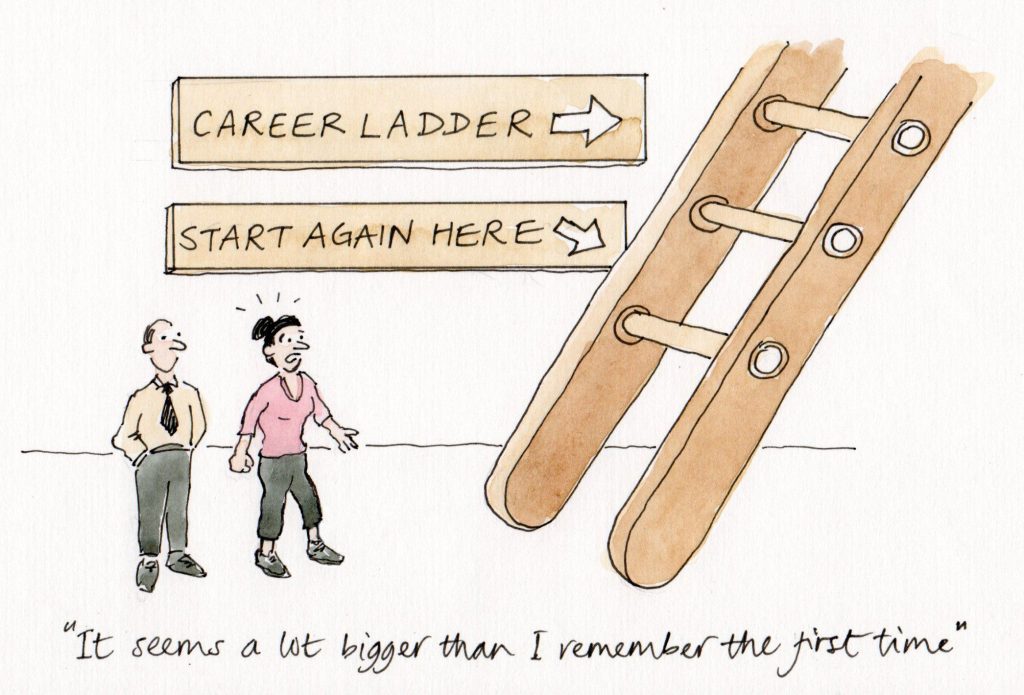
·       Worrying about money, making the wrong decision or taking a step down the ladder having worked so hard to progress up it

·       Not knowing what you don’t know

·       Being in the dark about how to find out about new options 

·       Believing they are ‘too old’ to change

·       Pleasing others e.g. parents living their lives through their children’s success instead of focusing on their happiness

·       Lack of time

No alt text provided for this image

·       Not wanting to let go of a benefit of the current job e.g. being admired at parties for being a Doctor

11 Tips to reinvent your career

1.  Research employment growth areas; sectors and jobs

2.  Think about when you have felt most alive and fulfilled in your work and how you can have more of this

3.  Source examples of achievements and initiatives from outside your career to demonstrate your marketability

4.  Think your career change through thoroughly and create a long term vision with small short term steps

5.  Make time regularly to make your change happen

6.  Research your options and ensure they will give you what’s important to you e.g. security, learning or challenge

7.  Consider retraining and acquiring new skills to become more marketable

8.  Analyse what makes you distinctive to other people in your field – that unique combination of your skills, qualities and life and work experiences – this is your unique ‘brand’

No alt text provided for this image

9.  Speak to people already doing what you want to do to get inside knowledge

10.               Be creative about how you can get experience to prove your capability and demonstrate the transferability of your skills in a new area e.g. do voluntary work, help out a friend’s business etc 

11. Enlist the support of an experienced career coach

Get in touch

Client testimonials

“Energise helped me focus on my strengths at a very negative time for me, during redundancy. I found the whole process very rewarding.”

“Coaching has given me extra confidence. The process was very rewarding. The CV now looks punchier, and I feel ME again.”

“Coaching with Energise has given me choices, freedom and liberation.”

“Coaching gave me an objective, practical and understanding sounding board when I needed to get my life back in gear again. It really is a personal service that works around who you really are and what you really want to do. “

“Coaching gave me a positive attitude, confidence and insight. It has been instrumental in my success and by setting targets and deadlines it has speeded up the whole process of finding another job.”

More client testimonials

Filed Under: Career change Tagged With: Career change, career pivot, career reinvention, energise the talent liberation company, portfolio careers, rachel brushfield, redundancy, the talent liberator

Exercising your entrepreneurial muscle

June 19, 2020 By //  by Rachel Brushfield

More competition for jobs and consultancy work makes being entrepreneurial as well as resilient essential.

The word entrepreneurial can make people put pressure on themselves, as it is associated with entrepreneurs, and many people don’t identify themselves in this way.

Alternative words for entrepreneurial

Other words that you can use instead of ‘entrepreneurial’ that may feel more ‘you’ are:

  • Enterprising
  • Imaginative
  • Ingenious
  • Inventive
  • Pioneering
  • Resourceful
  • Creative

Coronavirus has forced entrepreneurial behaviour

The coronavirus has seen a massive amount of fast change and reinvention with on-line learning and teaching, for example.

Our local pub is planning to re-open in July re-organised to accommodate social distancing with an App to pre-book tables and pre order and pay for food and drinks. Food and drinks will be placed in a holding bay, for people sitting at tables to collect themselves, protecting the staff and minimising touch and risk of infection, instead of staff serving at the tables. This system will also enable more planning, and perhaps less waste, with prior knowledge of what ingredients are needed and in what quantity.

Invention and innovation

Entrepreneurial behaviour underlies the inclination to undertake invention and innovation, including the creation of something new, as well as the distribution and adoption of the new throughout society. Think Zoom and Team which are now the norm, when a few months ago, not everyone had heard of or used them.

Portfolio careers require entrepreneurial behaviour

Entrepreneurial behaviours are essential with a portfolio career, a career made up of different work strands, where you create different opportunities for yourself. As an analogy, just as with cookery, the more ingredients that you have – skills, experience, knowledge and contacts, the more ‘recipes’ you can create for yourself.

What are entrepreneurial behaviours?

Confident/’can do’ attitude

Proactivity

Learning

A mistake/failure is an opportunity to learn/relearn

Try different things

Curiosity

Assertiveness

Being inventive/enterprising

Resilient

A preference for change

Desire to change the status quo 

How would you rate yourself currently on these entrepreneurial behaviours out of 100%?

Developing entrepreneurial habits helps to develop entrepreneurial behaviours.

10 habits of entrepreneurs

What are the habits of entrepreneurs?

1.  Plan a day in advance

2.  Get proper nutrition

3.  Position themselves to serve others

4.  Set clear S.M.A.R.T. goals

5.  Take calculated risks

6.  Know their strengths and weaknesses

7.  Hire ‘A’ team players

8.  Are constantly learning

9.  Always look for opportunities

10.               Evaluate their actions and priorities every day

6 tips to develop your entrepreneurial ‘muscle’

  1. Block out time in your diary each week for personal and professional development
  2. Diarise a half day or whole day away day every 2 months to think, reflect, plan and create
  3. Read Charles Handy’s book The New Alchemists
  4. Learn to coach yourself – ask yourself open incisive questions e.g. for a trainer: ‘What trends are growing in the tech sector that I could adopt for the training industry?’
  5. Diarise ‘important not urgent’ tasks to make sure that they happen. According to Stephen Covey, author of the international best seller The 7 habits of highly effective people these tasks are:
  • Preparation
  • Prevention
  • Planning
  • Relationship building
  • Empowerment
  • Self awareness, learning, exploration & development
  • Learning new skills
  • Creative thinking
  • Networking
  • Prioritisation
  • Training & development
  • Exercise 

6. Push out your comfort zone each week – do something that you have never done before

Get in touch https://www.inspiringportfoliocareers.com/portfolio/connect/

Filed Under: Entrepreneurial Tagged With: career coach, career pivot, career strategist, energise, portfolio career, portfolio careers, rachel brushfield, the talent liberator

How to future-proof your career

June 18, 2020 By //  by Rachel Brushfield

The Brexit/political impasse and more recently the impact of the coronavirus has been very stressful for many people

With redundancies now likely to be on the horizon, and many companies currently having recruitment freezes, it can feel very challenging indeed to get a job/paid work.

Even in these challenging market conditions, a sense of moving forward and progressing is vital.

So how can you take steps today to future-proof your career for the longer term?

This blog shares some practical tips and further reading to inspire and help you.

V.U.C.A. world
The current world is volatile, uncertain, complex and ambiguous, or V.U.C.A. This is the new ‘normal’.

Focus on how you can help senior management and businesses with the challenges they face, for example business agility and transformation, creating a competitive advantage, original communication etc.

The competencies of control, curiosity, commitment, confidence and concern are important to be adaptable in your career.

5 career adaptability competencies

  • Control – being proactive, decisive & taking responsibility for your career;
  • Curiosity – broadening your horizons by seeking options, possibilities and knowledge;
  • Commitment – passionately pursuing & taking action to move to the career horizon of your choosing;
  • Confidence – belief in yourself & that you can achieve your goal;
  • Concern – having a positive & philosophical attitude to mistakes or rejection.

How would you rate yourself on these competencies?

Here are some tips to future-proof your career.

Build your career adaptability competencies: If you think of the above career adaptability competencies as ‘muscles’, how can you exercise them? What S.M.A.R.T. goals can you set yourself and what CPD can you undertake to build these ‘muscles’? This will put you in good stead now and in the future.

Understand your transferable skills: Skills you possess are useful in many different contexts outside of your current sector. Investigate new work areas where the skills that you already possess are valued.

Look at trends: Keeping an eye on changing trends is very important at all times, and especially when things are changing fast, which they are at the moment. In any shrinking market, there will always be areas that are growing. What specialisms are growing, for example, cyber crime and data analytics? Where are there skill shortages?

Update your skills: There are lots of free on-line courses, called Moocs shared by universities all over the world. Take advantage of these to learn new skills and develop your knowledge. For example critical thinking is a key skill of the future. Change management and commercial awareness are also good areas to develop. What actions could you take to refresh and develop these specific skills?

Build your career capital: With more competition, you need to have a higher level of qualification to succeed, and add value. Consider new accreditation and building a specialism. Investment now can create more opportunities in future. Explore thought leadership and initiate key note/panel opportunities.

Widen your options: It is wise in uncertain times to develop a portfolio career. Rather than having all your career ‘eggs in one basket’, and just have one source of earning money, explore new/different options, and develop multiple strands to future-proof your career. This is called a portfolio career – it is ideal for uncertain times. You develop different work ‘strands’ so you can pivot as markets change and you change. As an analogy, as with ingredients and cooking a recipe, the more ‘ingredients’ you have of skills, knowledge and experience, the more you can create opportunities for yourself.

Become tech savvy: New tech tools can be daunting at first, but learning them satisfying. Being tech savvy is important so that you hit the ground running in work. If there are two candidates of comparable skill and experience, having superior digital acuity will go in your favour.

Broaden your network: In the digital age, it is becoming more important to have a large diverse network. Many networks are providing free Zoom sessions during lockdown – take advantage of this and attend some networks you wouldn’t normally consider to broaden your network. Join some new LinkedIn groups, and connect with the members.

Free resources: Take advantage of any free resources from your professional body. There may be webinars, case studies and other resources you can access on their website.

Do a skill swap: A skill swap costs nothing, and enables you to learn a new skill, for example Excel spreadsheets, social media, cashflow planning etc. When you’re worried about the future, skill swaps are a brilliant way to skill-up.

Consider retraining: Retraining into a work area where there are skills shortages is worth exploring to improve your security and prospects for the longer term.

Build your resilience: Some people are naturally resilient, but it is a skill that can be learnt. Persistence and not giving up are very important. Determination will take you a long way. In fact, according to Charles Handy, a pioneer in modern ways of working, in his book ‘The New Alchemists’, determination is THE no 1 factor for success. Don’t give up!

It can feel like very challenging times at the moment. Remember you are not alone. Keep going.

Contact us to receive a free report ‘Discover Portfolio Careers’ https://www.inspiringportfoliocareers.com/portfolio/connect/

Recommended further reading

Our articles for the award winning Future of Work Hub:

Future skills for a lifelong competitive advantage part 1 https://www.futureofworkhub.info/comment/2019/3/22/future-skills-for-a-life-long-competitive-advantage-part-1

Future skills for a lifelong competitive advantage part 2 https://www.futureofworkhub.info/comment/2019/6/26/future-skills-for-a-life-long-competitive-advantage-part-2

Filed Under: Career strategy and planning Tagged With: career pivot, career planning, career strategy, energise - the talent liberation company, portfolio career, rachel brushfield, the talent liberator

10 tips for happy self-employment – part 4 of 4

June 16, 2020 By //  by Rachel Brushfield

Self employment is on the rise. This is a 4 part article series sharing 40 tips for happy self-employment.

Read part 1 https://www.inspiringportfoliocareers.com/10-tips-for-happy-self-employment-part-1-of-4/

Read part 2 https://www.inspiringportfoliocareers.com/10-tips-for-happy-self-employment-part-2-of-4/

Read part 3 https://www.inspiringportfoliocareers.com/10-tips-for-happy-self-employment-part-3-of-4/

  1. Design and print high quality business cards – they speak volumes about you
  2. Networking selectively for your own specialism

3.  Have a superb support system e.g. bookkeeper, proactive accountant, IT, virtual PA

4.  Develop and hone efficient expedient systems, e.g. physical paper and computer file folders from the outset

5.  Back date purchases before you set up your business 

6.  Be adaptable and open to new avenues and opportunities – learn as you go along, learn then teach to embed new learning

7.  Create your own personal image – be authentic

8.  Have a plan but be agile – see what clients/projects you attract

9. Set continual professional and personal development S.M.A.R.T. goals

10. Diarise time for the opposite of what you naturally are drawn to do. E.g. if you are naturally positive and think about what you HAVE done, make time to think about what you HAVEN’T done

Get in touch https://www.inspiringportfoliocareers.com/portfolio/connect/

Filed Under: Self employment Tagged With: career pivot, energise, freelance, rachel brushfield, self employment

10 tips for happy self-employment – part 3 of 4

June 16, 2020 By //  by Rachel Brushfield

Self employment is on the rise. This is a 4 part article series sharing 40 tips for happy self-employment.

Read part 1 https://www.inspiringportfoliocareers.com/10-tips-for-happy-self-employment-part-1-of-4/

Read part 2 https://www.inspiringportfoliocareers.com/10-tips-for-happy-self-employment-part-2-of-4/

1.  Follow up is key – don’t waste effort going for the ‘new shiny thing’

2.  Be clear on your attitude to risk

3.  Adopt smart tech to work expediently and plan IT reviews and updates

4.  Create a financial ‘cushion’ for quiet times 

5.  Design your business and working environment around your personality type e.g. extrovert or introvert

6.  Make the most of the quiet months (August/December/January) to think and plan, don’t worry that it is quiet – it is a gift! 

7.  Utilise the support of a Virtual PA – play to your strengths

8.  Be honest with yourself – what do you really want, rather than what you think you should do?

9.  Know the key words for your specialism – use Google Keyword planner

10.               Define your personal brand and personal brand assets, e.g. avatar – this is increasingly important in the digital age

Get in touch https://www.inspiringportfoliocareers.com/portfolio/connect/

Filed Under: Self employment Tagged With: career pivot, energise, freelance, portfolio careers, rachel brushfield, self employment, the talent liberator

  • Go to page 1
  • Go to page 2
  • Go to Next Page »

Primary Sidebar

Sign Up for Our Newsletter

Privacy by SafeUnsubscribe

Looking for something?

  • Being
  • Career agility
  • Career capital
  • Career change
  • Career coaching
  • Career fulfilment
  • Career prospects
  • Career satisfaction
  • Career strategy and planning
  • Change and uncertainty
  • Clarity
  • Confidence
  • Contracting and interim
  • Creativity
  • Diversity & inclusion
  • Emotonal intelligence
  • Employee engagement
  • Employment law
  • Entrepreneurial
  • Evolving a business
  • Fear
  • Flexible working
  • Freelance
  • Future-proof your career
  • Goals
  • Guest blog portfolio career
  • Habits
  • Happiness
  • Health
  • Hobby becoming a business
  • Interviews
  • Learning
  • Managing emotions
  • Marketing and selling
  • Money and abundance
  • Motivation
  • Networking
  • New year
  • NLP
  • Optimism
  • Performance
  • Personal brand
  • Personal development
  • Portfolio career
  • Productivity
  • Redundancy
  • Reflection
  • Relationships
  • Resilience
  • Retirement
  • Returners
  • Second careers
  • Self employment
  • skills
  • Small businesses
  • Social business
  • Social media
  • Starting a business
  • Stress
  • Success at work
  • Supporting our network
  • Talent management
  • Thought leadership
  • Transferable skills
  • Uncategorized
  • Unretirement
  • Vaues
  • Women
  • Work
  • Work life balance
  • Work trends
  • Working mothers

On Twitter

Twitter Sent An Error: Could not authenticate you.
  • Facebook
  • LinkedIn
  • Twitter
  • Website Terms & Conditions
  • Cookie Policy
  • Privacy Policy

+ 44 (0) 845 22 55 010
rachel@inspiringportfoliocareers.com

Copyright © 2026 Inspiring Portfolio Careers from Energise, The Talent Liberation Company · Site Design by DigitalJen ·

We use cookies to ensure that we give you the best experience on our website. If you continue to use this site we will assume that you are happy with it.