
• Menu
  • Skip to primary navigation
  • Skip to secondary navigation
  • Skip to main content
  • Skip to primary sidebar

Inspiring Portfolio Careers

From Energise - The Talent Liberation Company

  • Home
  • You
    • Why choose a portfolio career?
    • Who is a portfolio career for?
    • What is a portfolio career?
    • When is it time for a portfolio career?
  • Us
    • Why choose us?
    • What is our approach?
    • What are our values?
    • Who are our clients?
  • Services
    • On-line programmes
    • Career Coaching
    • E-Course
    • Skills CV Design
    • Marketing Mentoring
    • Personal Branding
    • Booking
  • Inspiration
  • Testimonials
  • Blog
  • Contact Us
  • Website Terms & Conditions
  • Cookie Policy
  • Privacy Policy
  • Home
  • You
    • Why choose a portfolio career?
    • Who is a portfolio career for?
    • What is a portfolio career?
    • When is it time for a portfolio career?
  • Us
    • Why choose us?
    • What is our approach?
    • What are our values?
    • Who are our clients?
  • Services
    • On-line programmes
    • Career Coaching
    • E-Course
    • Skills CV Design
    • Marketing Mentoring
    • Personal Branding
    • Booking
  • Inspiration
  • Testimonials
  • Blog
  • Contact Us

Blog

What are the legal implications of job change? Part 2.

September 14, 2013 By //  by DigitalJenIPC

Path through green grass

This is a guest blog – part 2 of 2 by Michael Scutt who is an employment lawyer. It explores garden leave, restrictive covenants and bonuses.

Garden leave
Another option open to employers is to place the departing employee on garden leave. This means that the employee remains just that, an employee for the duration of the notice period. The only difference is that they remain at home and will not be doing any work. Whilst on garden leave, the employee is entitled to continue to receive all salary and benefits but they must not compete against the employer or work for anyone else. A garden leave clause can be a most effective way of keeping an employee out of the job market and is likely to be more enforceable than a restrictive covenant.

Restrictive covenants
Restrictive covenants come in various forms. Basically it is a type of clause that seeks to prevent the departing employee from undermining the business after they have left. Common restrictive covenants include non-solicitation of clients or prospective customers, non-poaching of colleagues and non-competition clauses. They can be for varying periods of time, such as one, three or six months, but the longer the duration, the more unlikely it is that clause would be enforceable, particularly with a non-compete clause which seeks to prevent an employee from working in the same business. This is a very complex area and close scrutiny needs to be given to such clauses if you are the employee seeking to leave. Traditionally the courts have been reluctant to enforce restrictive covenants and will only do so if they protect a legitimate business interest of the employer. In other words, a non-compete or non-solicitation clause against a senior salesman is likely to be more enforceable than against a receptionist or back office administrator with no client contact.

Discretionary bonus
Don’t forget about any bonus that may be due. Many contracts of employment will contain a provision that the employee is paid an (often discretionary) bonus provided they remain in employment or are not under notice at the time the payment is made. Consequently, before handing in your notice you need to check to make sure that you will not be forfeiting that bonus if you leave at that time. In some cases it may be possible to negotiate for your new employer to pay you the bonus you are otherwise forfeiting in joining them, but that is a rare situation.

Finally, in some employment contracts you will find a provision that states you will bring the existence of restrictive covenants in it to the attention of your new employer. If there is subsequently a dispute and you fail to notify the new employer of the relevant clauses in the contract, it could lead to you being sued by the old employer, who will probably also take action against your new employer.

In summary then, when considering changing jobs it is worth checking your existing contract of employment and, if necessary, take advice from an employment lawyer. At the same time you could also take advice on the terms of the new contract you are being asked to enter into so that you are forewarned for any future issues that may arise when you finally move on from that employment.

In case you missed it, here is part 1:

http://liberateyourtalent.wordpress.com/2013/08/11/what-are-the-legal-implications-of-job-change/

Michael Scutt is an employment solicitor with Excello Law. (http://www.excellolaw.co.uk/solicitors/michael-scutt/) He can be contacted via mscutt@excellolaw.co.uk or (01707) 471030 or 0845 257 9449 Follow Michael on Twitter https://twitter.com/michaelscutt


Filed Under: Uncategorized Tagged With: being made redundant, bonuses, compromise agreement, employment advice, employment lawyer, energise, Excello law, garden leave, losing your job, Michael scutt, rachel brushfield, restrictive covenants, talentliberator

Yes! But, but, but…..

August 27, 2013 By //  by DigitalJenIPC

Obstacle course 3 (2)

What’s your ideal career? Is it what you are doing now? If not, what are you doing about it?

Many people want to change career, get to the starting blocks, and then find ‘buts’ and never move any further. So how can you overcome fear?

The thing is ‘buts’ are normal and part of the career change process. Identifying them and working out how to get around them or jump over them is important.

‘Buts’ can be big or small, but they are still ‘buts’.

BUT what will my parents think?

BUT what if I make the wrong decision?

BUT what impact on my employment rights?

BUT how long will it take?

BUT where else are my skills and experience useful?

Sound familiar?

It is easier to overcome the ‘buts’ with support. Talking with friends and family can add to the ‘buts’ because they give their view and see problems and risks rather than seeing the situation through your eyes. Not everyone will welcome the change that you need, sometimes because it affects them in a way they don’t like.

A career coach like me champions you and is experienced at the process of career change and the natural fear and buts that arise. Our society isn’t especially open in talking about fear.

Some of the ‘buts’ my clients have tackled have been:

– A lawyer dealing with their father’s disappointment of not wanting to remain in the law
– A teacher sourcing a certificate from their native Italy years after doing the exam to be able to apply to do a course to retrain
– A Doctor letting go of the high regard of others ‘oh, you’re a Doctor?’ at parties

and many clients working through dealing with unknowns and uncertainties and the perceived risk in a challenging market

What would your ‘buts’ be?

Black and white thinking is common – all or nothing. In reality, there is always more than one option.

To follow us on Twitter:
https://twitter.com/talentliberator

Have you downloaded our free PDF to identify what your transferable skills are? Click on this link:

Free Skills download:
http://careerstrategies.co.uk/changingcareersreport/

Filed Under: Career change Tagged With: buts, energise, fears about change, new career, rachel brushfield, talent liberator

What are the legal implications of job change?

August 11, 2013 By //  by DigitalJenIPC

Careers next exit signpost

Thinking of changing jobs or know someone who is?

At a career crossroads, whether changing jobs or becoming self-employed, it is important to make a robust decision, having thought about all the implications of your planned change. These implications need to include legal ones which affect your rights and choices.

This is a guest blog, part 1 of 2, by Michael Scutt who is an employment lawyer. It explores the employment law implications of changing jobs, specifically your notice period.

Changing your job can feel a risky and anxious experience. There may be many reasons why you are changing your job; dissatisfaction at a lack of prospects, wanting more pay or responsibility, feeling undervalued or simply relishing a new challenge. However, for some, there can be truth in the old adage of “better the devil you know”. For the more risk averse, making the decision to leave voluntarily can therefore be a daunting step.

In many situations, the decision to change jobs can be forced upon an employee by redundancy or dismissal, but whatever the reason for departure from one job, it is never an easy step psychologically.

So what are the legal issues you need to think about before ‘jumping ship’?

Your notice period
The first step is to look at your contract of employment. How much notice do you have to give before you can leave? In many cases, and it depends on your seniority in the business you are leaving, your notice period may be no more than one month or, depending on length of service, one week per year of service up to a maximum of 12 weeks (being the statutory notice due). In other cases, particularly with more senior employees, the period of notice you are required to give maybe three or even six months. Only very senior employees might be required to give 12 months notice.

In the absence of anything in writing, the statutory provisions will prevail being such period as is ‘reasonable’ in all the circumstances. You should not work for a new employer until your notice period has expired. Again, a look at your employment contract will tell you whether your employer can pay you in lieu of notice (called a ‘PILON clause’), meaning they can pay you the money you would have received during your notice period (had you served it) in a lump sum. If there is no PILON clause in your contract, your employer may be able to pay you the value of the notice period gross of tax and National Insurance contributions.

However, if you are the one who instigated the move, it is unlikely that your employer will wish you to leave so quickly, particularly if there is any risk that you might take their clients or customers with you to your next job. On the other hand, if the employer is terminating your employment, perhaps for reason of redundancy, they may be prepared to pay you in lieu of notice. If the departure is likely to be amicable, then it can be worth speaking to your employer to negotiate the timing of your exit.

When considering changing jobs, it is worth checking your existing contract of employment and, if necessary, take advice from an employment lawyer. At the same time you could also take advice on the terms of the new contract you are being asked to enter into so that you are forewarned for any future issues that may arise when you finally move on from that employment.

Visit this blog again in two weeks for part 2 which explores garden leave, restrictive covenants and discretionary bonuses.

Michael Scutt is an employment solicitor with Excello Law. (http://www.excellolaw.co.uk/solicitors/michael-scutt/) He can be contacted via mscutt@excellolaw.co.uk or (01707) 471030 or 0845 257 9449. Follow Michael on Twitter https://twitter.com/michaelscutt
Filed Under: Employment law Tagged With: changing jobs, contract of employment, employment contract, Employment law, energise, Excello law, jobs, Jobsworth blog, Michael scutt, rachel brushfield, talent liberator

11 career steps to a second career

August 5, 2013 By //  by DigitalJenIPC

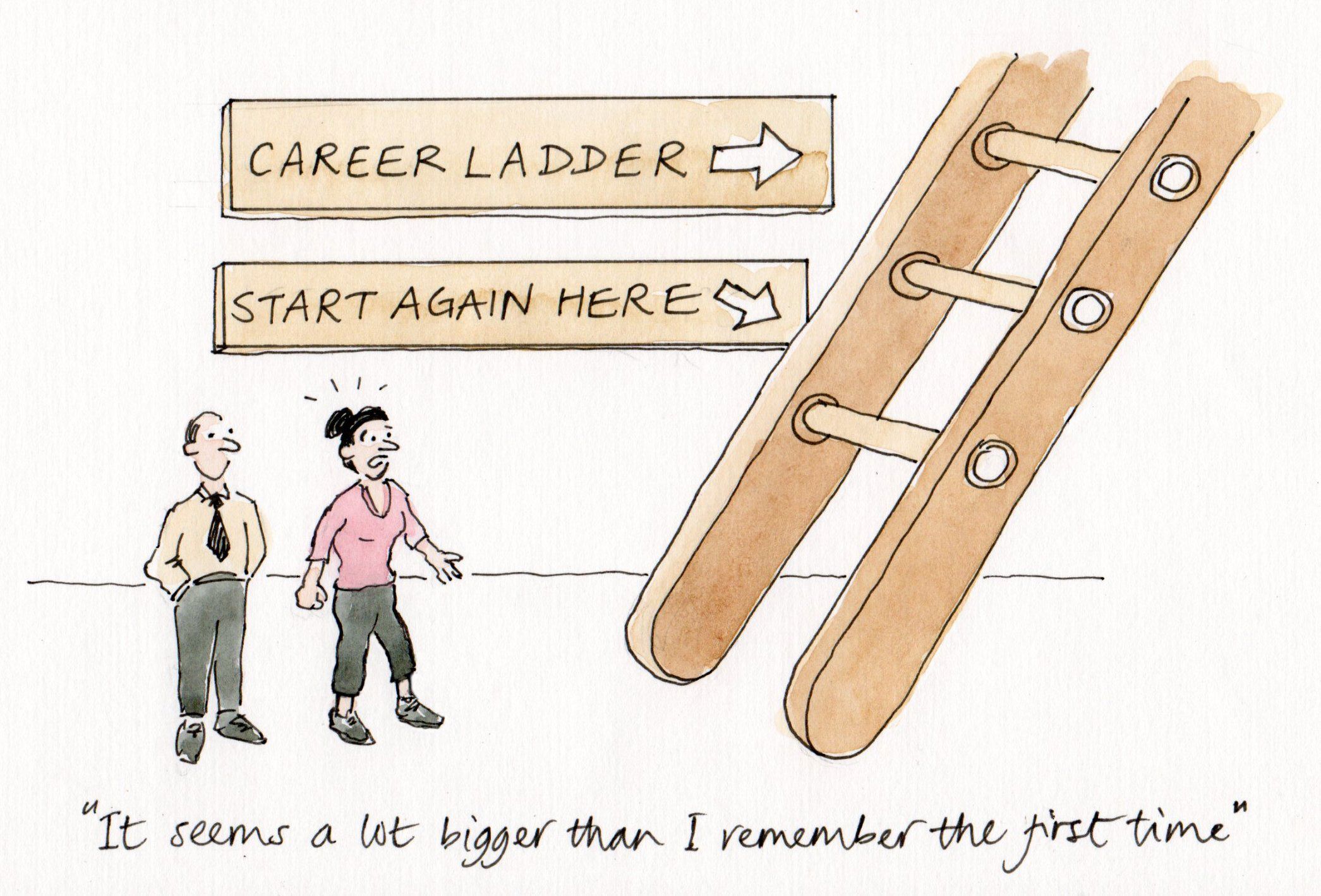
Cartoon 14 Career Ladder

Fancy a second career different to your first? Many people fall into their first career, so it’s not surprising that more and more people are seeking a second career.

It can feel like a void when you change career, so it helps to have career steps to pave the way to your future.

Last week I did telephone coaching sessions to prepare two clients practically and mentally in their decision to negotiate a career step in their career change.

Client A is working full time and wants to change career direction and needs to be able to do an internship in the Autumn in their new area of work. They broached the subject of a sabbatical with their line manager with 3 options. It went really well and it is looking like a ‘yes’ to the sabbatical.’

Client B’s current role is being made redundant and they have been offered alternative roles but are concerned that this is not the right choice for them and they want to take the opportunity to do something different. Result – they successfully negotiated redundancy.

Coaching is really useful to help people to prepare and think through different options, make the right decision for you and communicate this in the best way to the target audience to achieve your desired outcome.

What could your stepping stone be to a different career? In future, work will become much less guaranteed and more transient with temporary assignments the norm for many of us, so this is an important thing to start thinking about.

Here are 11 possible stepping stones to pave the way for your new career:

1. Get made redundant and get a lump sum
2. Take voluntary redundancy and get a lump sum
3. Take a sabbatical
4. Take a career break
5. Switch from working full time to part time with your current employer
6. Leave your current employer and do contracting/interim work in the same industry/profession
7. Switch from full time employment to freelance project work in the same sector
8. Help out a friend in their business to gain new experience
9. Save up a cushion to dedicate to creating your career change
10. Do some volunteering
11. Fund your own retraining while still self-employed to broaden your skills, qualifications and choices

What other career steps would you add?

If you are thinking about career change, start the career steps to your new career this August.

For more insights and tips, follow us on Twitter:
https://twitter.com/talentliberator

Have you downloaded our free PDF to identify what your transferable skills are? Click on this link: http://careerstrategies.co.uk/changingcareersreport/

Filed Under: Career change Tagged With: Career change, career steps, energise, new career, rachel brushfield, second careers, talent liberator

Is a new career like a marathon?

July 29, 2013 By //  by DigitalJenIPC

623-01741727

I was chatting to a potential client last week who runs marathons. How they approached the 26 mile race reminded me of people who want a new career.

Many people want a new career, but it feels so huge and overwhelming that they never start.

If a marathon runner dwelled on the fact that they had to run for 26 miles, they would probably be put off doing marathons, whereas if they focus on 1 mile at a time, the race is far less daunting.

The same is true with a new career – it is a big decision and best tackled one step at a time.

The world is changing so fast, taking this approach with a new career is wise because you can review your strategy as you go along, just as a marathon runner would depending on the weather conditions, speed of the other runners, terrain etc.

How do you perceive a new career? What would be your first step?

August is a great time to start so you are prepared and ready in September.

To follow us on Twitter, click on this link:
https://twitter.com/talentliberator

Free Skills download:
http://careerstrategies.co.uk/changingcareersreport/

Read about two of our clients who created a new career:

Persistence to realise a career vision (Anna)
http://archive.constantcontact.com/fs042/1102862873131/archive/1106812347557.html

Starting a charity (Mary)
http://archive.constantcontact.com/fs042/1102862873131/archive/1106770362344.html

Filed Under: Career change Tagged With: a new career, career, Career change, career change tips, energise, rachel brushfield, talent liberator

Does your job ever make you weep?

July 24, 2013 By //  by DigitalJenIPC

Fed up man


I had an e mail this week from a potential client. I bet some of you can relate to what they said in their e mail or know someone it reminds you of:

“I am not happy in my current role and have for a while been thinking about what to do next. I know I do not want to stay in my current profession but in truth do not know what I want to do. This has been brought to the fore last week as I was put at risk of redundancy by my employer although there are a number of new posts that I could apply for and I think the expectation is that I will take one of these. This would be the easy option but I think will still leave me wondering ‘what if?’

‘What if?’ is a hard one isn’t it? It is in the future and an unknown quantity, so you don’t know if you will wish you had done something differently and have regrets or not.

This week I have worked with a number of new clients who hate their job/career. It is not uncommon for them to feel depressed and sometimes they cry in the session because they are so fed up of feeling fed up.

It is not surprising is it? As a metaphor, it is a bit like a plant trying to grow without any sunshine and in the wrong environment for it to thrive.

When we first start working together, we do a session in two hours which helps them to identify what motivates them and what is important to them (their values). They quickly see that their job or career is not giving them these things. You can see the light bulb go on. Sometimes moving department or company can make all the difference, but for many changing career is what they choose to do.

Career change is a big decision so we tackle it thoroughly, strategically and practically.

Who do you know who is wondering ‘What if?’ It is never too late to change track, get on the right path and have more career fulfillment.  Summer is a great time to do the career change programme when the pace of life and work is a little less frenetic.

Here are a couple of examples of career change:

Anne

http://archive.constantcontact.com/fs042/1102862873131/archive/1108092201346.html

Duncan

http://archive.constantcontact.com/fs042/1102862873131/archive/1106786590378.html


For more insights and tips, follow us on Twitter:
https://twitter.com/talentliberator

Filed Under: Career change, Uncategorized Tagged With: career, Career change, careers advice, energise, new career, rachel brushfield, talent liberator

Pigeon holed at work?

July 20, 2013 By //  by DigitalJenIPC

Disinterested


Call it ‘pigeon holed’ or being ‘put in a box’, it can be very annoying and restrictive. This is even more the case if you fell into your career by accident/chance, which many people do, and your job just isn’t ‘you’.

Why does pigeon holing happen?

Sometimes it suits your company to keep you in a certain role or just doing particular tasks. It may be that you are really good at what you do, but it doesn’t make you feel fulfilled.

I am a natural organiser for example, but it doesn’t give me a ‘buzz’. HR can think of people as job descriptions, roles and headcount rather than people with unique talent to be utilized in different ways.

It may be that your boss doesn’t like certain tasks, so it suits them to get you to do these, so they just do the bits they enjoy. Because they are ‘the boss’, they can.

Recruitment agents can be very good at pigeon holing candidates, after all it suits them to place candidates in the ‘holes’ that their clients are looking for because that is when they get paid. I have found many times with clients changing career direction, they find recruitment agencies just don’t get it.

A career coach like myself helps clients to reposition themselves and become what they want to be, not what they have been.

I hate being pigeon holed. Variety and newness are two of my values. I can’t think of anything worse than doing the same thing over and over again for the rest of my working life. It suits some people, to them it’s familiar and comfortable, but not me.

If you are feeling trapped in a pigeon hole, what do you do? Here are some tips

– Restructure your CV
– Choose a portfolio career
– Do volunteering to broaden your skills and experience
– Move employers
– Get a career coach
– Identify what perceptions people have of you, who your stakeholders are and create a communication plan to change them
– Discuss job redesign with your boss
– Learn a new skill/study for a qualification

What tips would you add?

It can be very hard to change perceptions of yourself with your existing company – especially if you were a placement student and you join the same company as an employee after you graduate.

Moving companies can make all the difference but sometimes a career change is the only way to find the right hole (or holes) for you.

Are you feeling put in a pigeon hole at work? Maybe you are in the wrong career, it’s just you have never admitted it to yourself or thought it was too late to do anything about it. It isn’t. Get in touch.

For more insights and tips, follow us on Twitter @talentliberator

Filed Under: Work Tagged With: blog, bored at work, careers advice, energise, in the wrong job, rachel brushfield, talent liberator, work frustrations

Fancy being a content curator?

July 6, 2013 By //  by DigitalJenIPC

Pile of papers overwhelm

Content curation is one of two phrases I heard this week for the first time.

The other one was ‘Digital shadow’. I love new things. It can be a bit tiring but it makes me happy!

“Content curation is the gathering, organizing and on-line presentation of content related to a particular theme or topic”.

Content curation is a skill and an art – what to include, what to leave out and how to express/present it.

Portfolio careers used to be new – the perfect second career for people like me who love variety and who would rather have work like tapas or dim sum than just 1 main dish.

Apparently 90% of the information on the web has appeared in the last 2 years. That is enough to make your head explode, hence the need for content curators to manage and make sense of it.

A museum like the V&A, for example, only has a small proportion of items on display. They have been careful selected and displayed. The rest are archived.

The world needs content curators with people becoming information grazers and a shorter attention span. I am even worrying about this blog being too long. … Bear with me though.

A common worry for people who come to me wanting a second career is that they don’t like what they are doing, but they don’t know what else they could do instead. They can go round and round in circles feeling stuck and frustrated. Another block to career change is that people cannot see how their skills are transferable to do something else, as they have been doing one thing all their lives, sometimes for the same employer.

Luckily I am the mistress of reinvention and have a broad network and constantly connecting mind – (wish it had an ‘off’ button), so am good at helping people to see their skills, how they are transferable and new careers where they can be applied.

New careers like content curation are appearing all the time and sometimes, a bit like with new product development, needs can be created when people did not know that they had them. Imagine creating your own career playing to a strength, hobby or passion!

Many moons ago, I worked as an account planner in the advertising and communication industry for JWT, little did I know it, but I ‘content curated’ all the time, synthesising research into a creative brief, a white paper, useful insights & ideas or a brand positioning. I remember to this day, my first freelance project for what became a regular client. This gruff Yorkshireman (I love Northerners) dumped a huge stack of research reports on my desk and said: “Right then, let’s see what you can do with that little lot by 5pm today.” It felt like an exam! I delivered. Phew!

It was the beginning of my content curator career, although I did not know it at the time.

Good content curation is a bit like an iceberg – there is only a small bit visible compared to the amount of work that was put into it.
So if you are at career crossroads, don’t worry. Your perfect second career might be emerging as we speak.

What new careers have you heard about recently?

PS By the way, if anyone knows what ‘digital shadow’ is, do let me know, as I haven’t discovered the answer yet.

To read our bulletin about Portfolio careers, click on this link:
http://archive.constantcontact.com/fs042/1102862873131/archive/1103260139794.html
To read about Anne’s career change from market research to facial workouts, click on this link:
http://archive.constantcontact.com/fs042/1102862873131/archive/1108092201346.html

For more useful insights and tips, follow us on Twitter:
https://twitter.com/talentliberator

Filed Under: Career change Tagged With: career, career ideas, content curation, content curator, energise, new careers, rachel brushfield, second careers, talent liberator

Mind the gap

June 30, 2013 By //  by DigitalJenIPC

Man on type rope above city stress

Do you find career change daunting? 

Many people want to make a career change, but choose to stay put instead. With an uncertain economic situation and with perceived security, this is a common choice. But at what cost?

Sitting on a fence for too long gets a bit sore.

Many people will happily buy 2 coffees a day or eat out three times a week, or buy clothes and shoes, the money for which over a year would fund a career coaching programme or a course to further their skills. We call this unconscious eating, drinking, shopping habits; ‘filling a gap’. Sound familiar?

Better to mind the gap than fill it.

This week during a coaching session with a client their fear about career change was palpable. Our client was clear about where they wanted to go, they had an impactful CV, and are extremely marketable. But they were in the void.

What is the void?

It is a place of ‘not-knowing’ and not knowing is scary and unfamiliar.

You have gone beyond where you have been in your career but not yet reached where you are going to be, and you don’t know how you are going to get there. People who have only worked in one company or type of work feel this especially strongly.

At this point in the process, common questions and themes are:

– How do ask for introductions?

– How do I get on the radar of headhunters?

– My network is very narrow, how do I build it when I am busy at work?

– How will I make the right decision?

– There is so much competition, how can I stand out?

We help our clients with these topics and a lot more, including creating a career strategy and plan and being a ‘Sherpa’ to help them get to their summit.

For those of you reading this, what are you doing to do this week to move your career in the direction you want it to go?

One action would be to set up a savings account to invest in your career, skills and knowledge. Even a small amount e.g. £5/week adds up over time.

In future, people will need a higher level of skill to secure the job they want, take responsibility for their own career, rather than leave it to their employer and to market themselves.

Be one of the wise ones.

Don’t wait for the end of the downturn to start creating your future.

For insights and tips, follow us on Twitter:

https://twitter.com/talentliberator

To read our Career Strategies, Smart living and working and Self-Promotion bulletins with useful insights and tips/opt in to receive future ones, click on this link:

http://www.liberateyourtalent.com/cms/index.php?option=com_content&view=article&id=79&Itemid=106


Filed Under: Career change Tagged With: a career change, Career change, changing direction, downturn, energise, new career, rachel brushfield, talent liberator

Lawyer career change – you can do it!

June 21, 2013 By //  by DigitalJenIPC

Success failure sign

The legal profession is experiencing huge change and a career change is a reality for many lawyers in the current market. The career model, like the law firm model, was fit for purpose yesterday, but not necessarily tomorrow. There are less partner places, and many associates are ‘caught in the middle’ and won’t achieve partner, some have a different career aspiration than partner wanting a better work life balance and more fulfilment or variety, and some will be pushed out or jump with the ‘up or out’ policy. Many lawyers fell into law, found out it doesn’t suit them and want to do something else, but what and how?

Career change can be a daunting prospect, especially in uncertain times. However people are so close to themselves that they cannot see how resourceful and well-equipped they are to tackle career change. Lawyers’ bright analytical minds can torture them in career change, going round and round in circles.

There is good news! Lawyers do have useful skills and experience to help them create a successful career change.

Here are 14 reasons why lawyers possess skills, qualities and experience that make them well-equipped for career change:

1. Research skill useful to explore new career options;
2. Intelligence to make a good decision;
3. Persistence to make it work, having spent many years training;
4. Society’s perception of lawyers as intelligent professionals to be respected and listened to helps you be considered as a candidate;
5. Rigorous approach analysing and synthesising information and seeing an issue from all angles;
6. Robust risk assessment and looking at different scenarios increases the likelihood of making a sound career change decision;
7. Keeping up to date with changes in the law – new careers are appearing all the time;
8. Love of knowledge and learning – get up to speed with a new area;
9. Commitment to study and learn serves well in getting up to speed in a new career;
10. Flexibility – experience of having different seats and working in different practice areas;
11. Tolerance and resilience acquired when junior working in a law firm;
12. Individualistic in nature – carve out own path in market;
13. Breadth and mix of skills needed to be a lawyer, i.e. critical thinking, client relationship management, negotiation, sharing complex information in a simple way – analysis and synthesis gives a transferable and useful skillset and good mix for becoming self-employed; and
14. CPD requirement to keep up to date with changes in legislation enhances being predisposed to skills refreshment.

Lawyers may not perceive it, but they do have useful skills and experience to make a change and are not the ‘one trick ponies’ than they often they think they are.

It is time for the rigid and linear lawyer career path in law firms to be changed.

We help lawyers to achieve career success – staying in the law and moving out.

Read our blog about how the very training that lawyers undertake can inhibit lawyers in career change:
http://www.energiselegal.com/2013/06/16/second-careers-for-lawyers/

Read our blog for The Law Society questioning the traditional role of partner:
http://www.energiselegal.com/2012/06/19/does-the-traditional-role-of-partner-need-to-be-reviewed/

If you are a lawyer at a career crossroads or a law firm wanting to be more innovative in your career model, e mail us for a confidential/no obligation chat:
http://www.energiselegal.com/contact-us/

Filed Under: Career change Tagged With: alternative careers for solicitors, alternative careers with a law degree, Career change, career outside the law, changing careers, energise, law related careers, lawyer career, lawyer career information, rachel brushfield, second careers for lawyers, talent liberator

  • « Go to Previous Page
  • Go to page 1
  • Interim pages omitted …
  • Go to page 23
  • Go to page 24
  • Go to page 25
  • Go to page 26
  • Go to page 27
  • Interim pages omitted …
  • Go to page 37
  • Go to Next Page »

Primary Sidebar

Sign Up for Our Newsletter

Privacy by SafeUnsubscribe

Looking for something?

  • Being
  • Career agility
  • Career capital
  • Career change
  • Career coaching
  • Career fulfilment
  • Career prospects
  • Career satisfaction
  • Career strategy and planning
  • Change and uncertainty
  • Clarity
  • Confidence
  • Contracting and interim
  • Creativity
  • Diversity & inclusion
  • Emotonal intelligence
  • Employee engagement
  • Employment law
  • Entrepreneurial
  • Evolving a business
  • Fear
  • Flexible working
  • Freelance
  • Future-proof your career
  • Goals
  • Guest blog portfolio career
  • Habits
  • Happiness
  • Health
  • Hobby becoming a business
  • Interviews
  • Learning
  • Managing emotions
  • Marketing and selling
  • Money and abundance
  • Motivation
  • Networking
  • New year
  • NLP
  • Optimism
  • Performance
  • Personal brand
  • Personal development
  • Portfolio career
  • Productivity
  • Redundancy
  • Reflection
  • Relationships
  • Resilience
  • Retirement
  • Returners
  • Second careers
  • Self employment
  • skills
  • Small businesses
  • Social business
  • Social media
  • Starting a business
  • Stress
  • Success at work
  • Supporting our network
  • Talent management
  • Thought leadership
  • Transferable skills
  • Uncategorized
  • Unretirement
  • Vaues
  • Women
  • Work
  • Work life balance
  • Work trends
  • Working mothers

On Twitter

Twitter Sent An Error: Could not authenticate you.
  • Facebook
  • LinkedIn
  • Twitter
  • Website Terms & Conditions
  • Cookie Policy
  • Privacy Policy

+ 44 (0) 845 22 55 010
rachel@inspiringportfoliocareers.com

Copyright © 2026 Inspiring Portfolio Careers from Energise, The Talent Liberation Company · Site Design by DigitalJen ·

We use cookies to ensure that we give you the best experience on our website. If you continue to use this site we will assume that you are happy with it.